The teenager is not wrong. You want a week of family time with the phones in a drawer; they want their friends, their own bed and enough signal to stay in the conversation they were in on Tuesday. Those are not the same holiday, and the trips that go badly are the ones where somebody has decided only one of them is a legitimate thing to want.
There is also a diagnosis to correct first. A fifteen-year-old who will not get out of the tent at eight is not being difficult. They are running a body clock that puberty has physically pushed later, and a week outdoors is the one intervention known to move it back. That turns the trip from the thing their sleep ruins into the thing that fixes it.
The conflict, stated plainly
The 2026 camping-trend reporting has half of campers planning a trip that recreates a childhood camping experience. The childhood is yours, and the teenager is not in the memory.
A number stops it feeling personal. Larson and colleagues, sampling 220 young people at 16,477 random moments for Developmental Psychology in 1996, found time spent with family falls from about 35% of waking hours at ten to about 14% at eighteen. Wanting to be elsewhere is the developmental job, and it would be happening if you had booked Rome.
Which sets up the reframe the rest of this runs on. You are not competing with the phone; you are competing with their friends, and the phone is only the door to them. Confiscating a door does not remove the want. What is left to negotiate — signal, sleep, privacy, autonomy, food, somewhere to go — is a set of booking decisions made weeks before anybody gets in the car.
They are not lazy, the clock has moved
The American Academy of Pediatrics' position is that at about pubertal onset most adolescents undergo a sleep–wake phase delay of up to two hours relative to middle childhood, driven partly by delayed nocturnal melatonin secretion. Release shifts to roughly ten or eleven at night, which makes falling asleep before eleven genuinely hard rather than merely unwelcome. Against that, the American Academy of Sleep Medicine's consensus is eight to ten hours per twenty-four for 13- to 18-year-olds, on a regular basis. Whoever gets in the car is already in deficit.
Then the finding that makes the whole trip worth defending. Wright and colleagues, in Current Biology in 2013, sent eight adults camping for a week with natural light and campfires only — no torches, no personal electronics. Average light exposure rose more than fourfold, and every measured marker of internal circadian time moved about two hours earlier. The largest advances were in the participants with the latest chronotypes: the self-described night owls moved most. A follow-up in 2017 found a weekend achieved roughly 69% of the shift a full week had produced. And a study of nine- to fourteen-year-olds at a camping programme found the same effect nearer the right age — dim-light melatonin onset advanced by about two hours over eleven to fourteen days, the greatest advances in the children who arrived with the most delayed sleep habits.
So stop fighting the first two mornings; nothing you do improves them. Get them into daylight early rather than out of bed early, because the light is the active ingredient and the discipline is not, and expect the clock to move on its own by about day four. A long weekend gets you most of the way. Plan the day to begin at eleven.
Signal and charging, as logistics rather than morality
The constraint is real, so treat it as a constraint rather than a character test. Ofcom's Connected Nations 2025 has 81% of UK landmass covered by good 4G from all four operators as of July 2025, and 96% from at least one; the Spring 2026 update puts the all-operator figure at 84%. The worst-served landmass is Scotland, Wales and the North East, which is inconveniently where the good sites are. Check the postcode before booking on Ofcom's Map Your Mobile checker, free and down to fifty-metre grid squares, which Ofcom itself calls a guide rather than a guarantee.
Then do the charging arithmetic out loud, because vagueness here is what produces the row on Wednesday. A current phone holds between about 3,700 and 5,100mAh: the iPhone 17 is 3,692, the 17 Pro Max 5,088. A 10,000mAh power bank does not deliver 10,000mAh into either — cells are rated at 3.7V and the phone charges at 5V, and conversion runs at roughly 65 to 75%, so what arrives is about 6,500 to 7,000mAh. One and a half to two full charges, for the week, shared. A 24,000mAh bank — the Anker 737 is 24,000mAh and 86.4Wh — is nearer four.
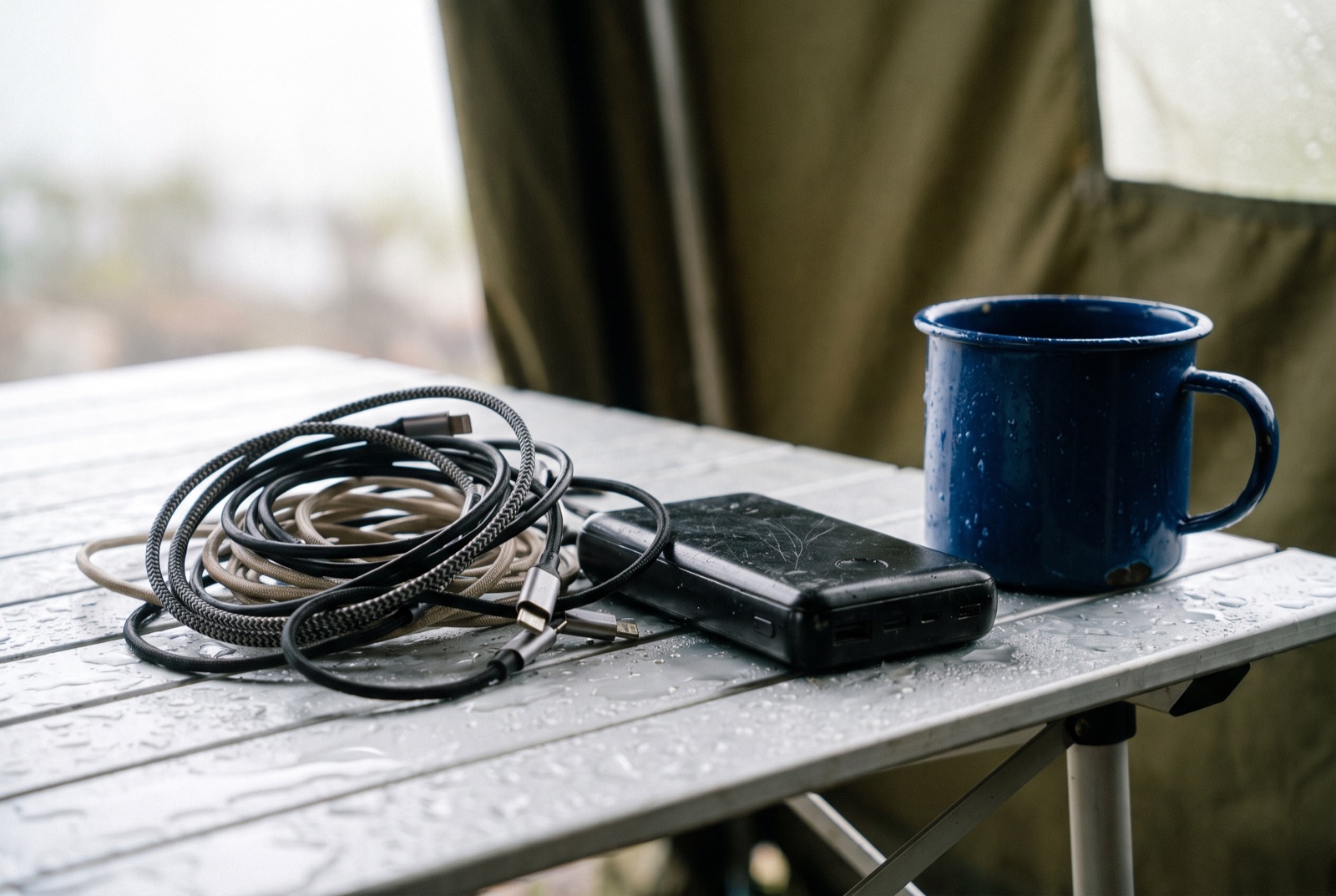
Three things solve it: a large bank charged at home, the car — a twenty-minute drive to the shop is a charge — and a campsite electric hook-up, where a 10A supply is about 2,300W at 230V and a 16A about 3,680W. Use a proper weatherproof hook-up lead rather than a domestic extension.
The negotiation is then simple, provided it is a deal and not a rule. Agree when the phones are out, not whether. Two honoured windows a day beats a confiscation that holds until Tuesday and then collapses in front of everybody.
A door, or at least a second tent
The single change with the largest effect on the week is somewhere they can be unobserved. A family tent does not have a shortage of privacy in it; it has none. A fifteen-year-old changing, sulking, messaging or crying is doing all of it eighteen inches from a parent, through fabric that stops nothing.
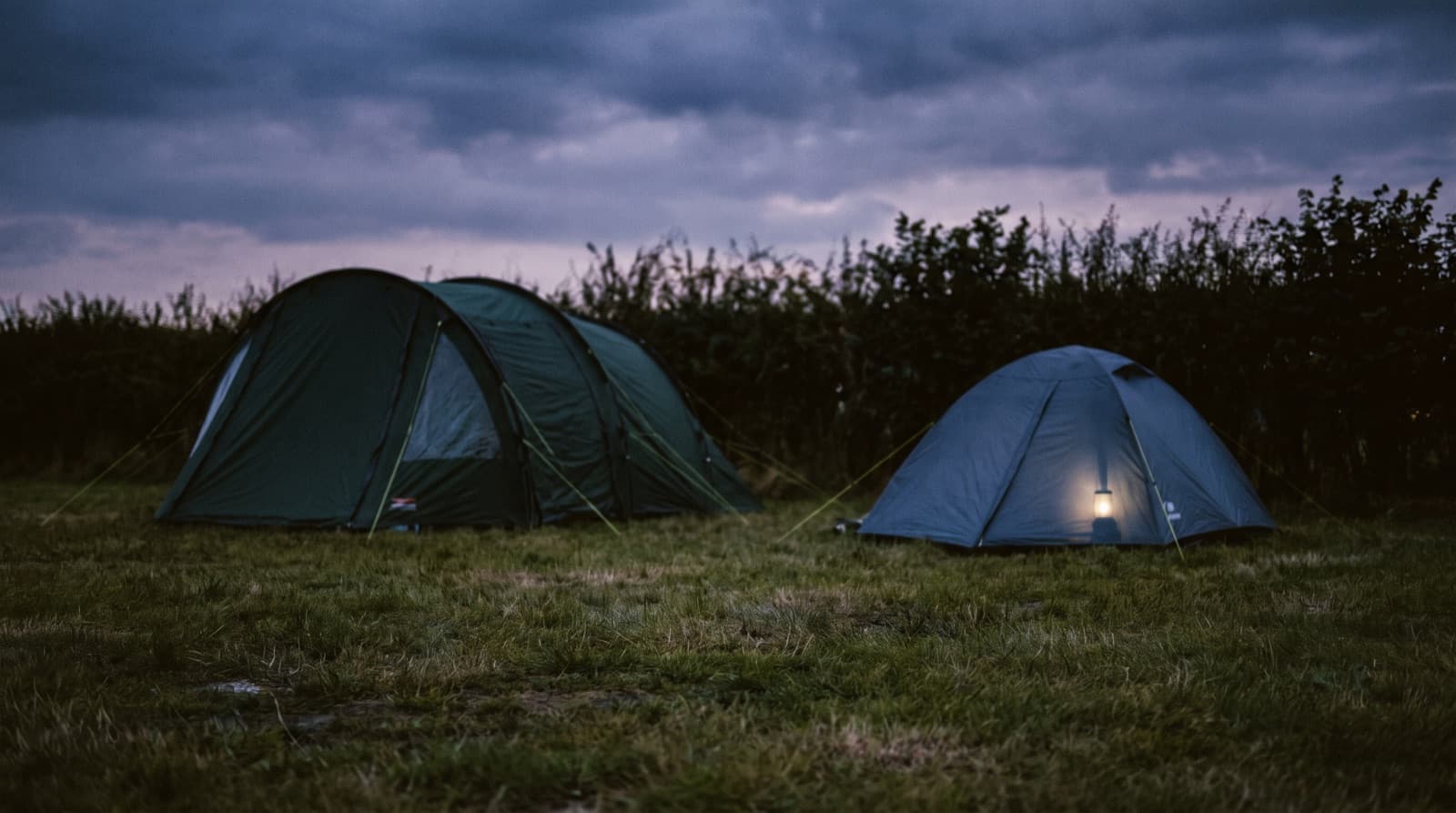
A cheap two-person tent pitched alongside costs less than one night's pitch fee and buys them a room. Two sharing it beats one alone, and both beat the pod at the end of the family tent, which is a partition rather than a door. In a cabin the same argument is a filter: a second bedroom that shuts is worth more than a hot tub. The under-threes piece makes the identical case at the opposite end of childhood.
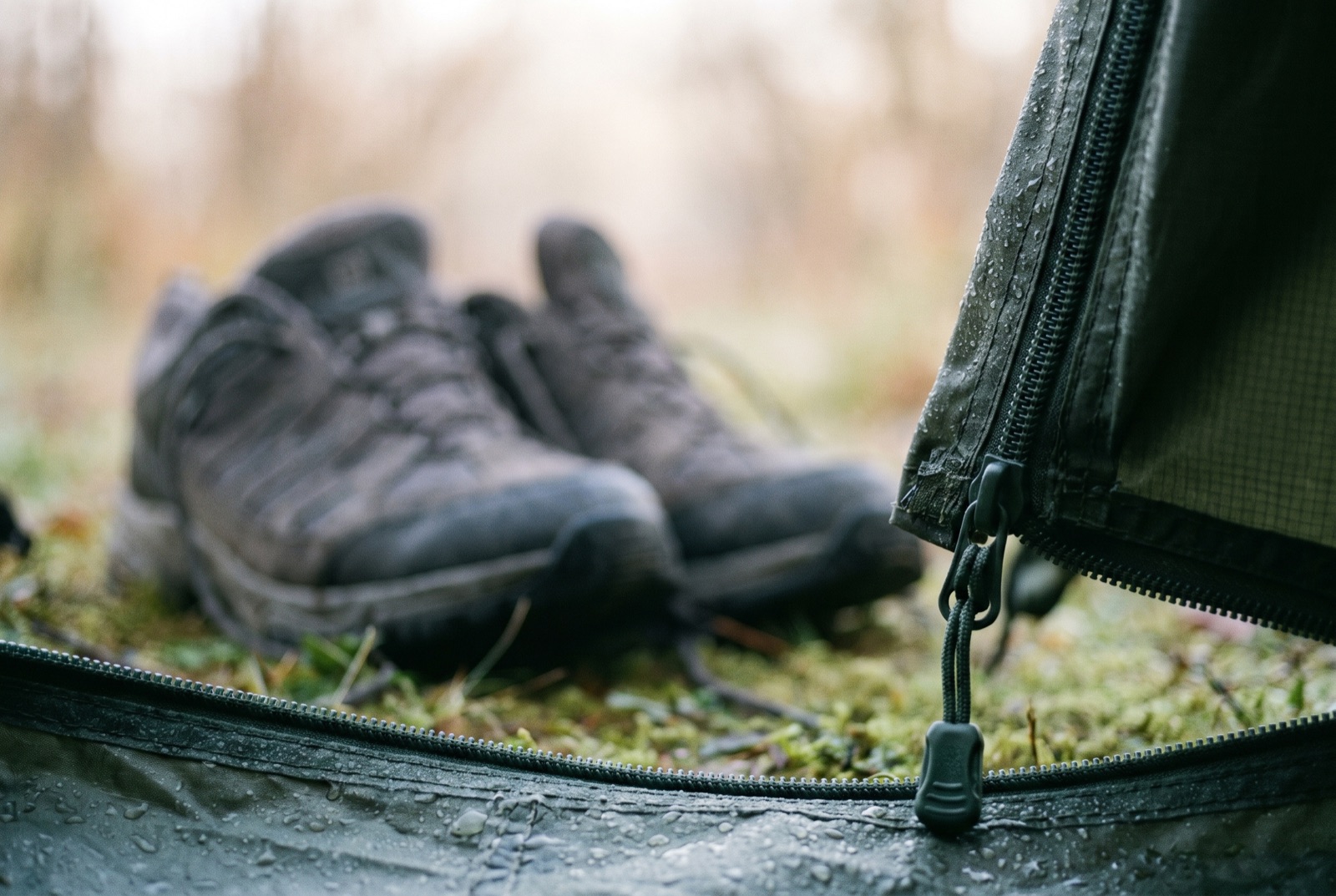
There is a consequence people miss. Teenagers now stay up later than you — the phase delay again, not defiance — and a separate tent lets them without the whole family being awake for it. The Camping and Caravanning Club's site terms prohibit noise and vehicle movement between 11pm and 7am; terms vary by operator, so read them and have the conversation on day one rather than day three.
A fifteen-year-old asleep at half past ten in the morning is the trip working, not the trip failing. Their clock has moved two hours, which is exactly what you brought them here for.
A real job, and the afternoon you leave them alone
A token job is transparent and will be resented accordingly. Fetching the water is a chore with a story attached, and a sixteen-year-old can tell the difference from across a field. A real job transfers authority: the fire is yours, the route is yours, Thursday's dinner is yours with a budget. The condition is that you accept it done differently and probably slightly worse. A meal you quietly improve is a job you have taken back.
Leaving them at the site is where preference stops and guidance begins. There is no legal minimum age in the UK for leaving a child alone, but there is a law against leaving a child alone in a way that puts them at risk — a different and much less convenient thing. The NSPCC's position, supported by the National Police Chiefs' Council, is that children under 12 are rarely mature enough to cope in an emergency, that it would not recommend leaving a child under 16 alone overnight, and that no child of any age should be left if they are not comfortable with it. That is their guidance, and not ours to convert into an age: no such age exists, and anybody offering you one has invented it.
The site often decides first in any case. The Camping and Caravanning Club's rules state that no children under the age of 18 are to be left unaccompanied on site at any time, and National Trust campsites require under-18s to be accompanied by an adult. Terms vary by site, so check what the site permits before promising an afternoon of freedom.
Somewhere to go, and how much they will eat
Choose the site for what is within reach without you: a beach, a trail network, a shop, a café, a bus stop. A beautiful field forty minutes' drive from anything is a site where you are the taxi and they are the passenger.
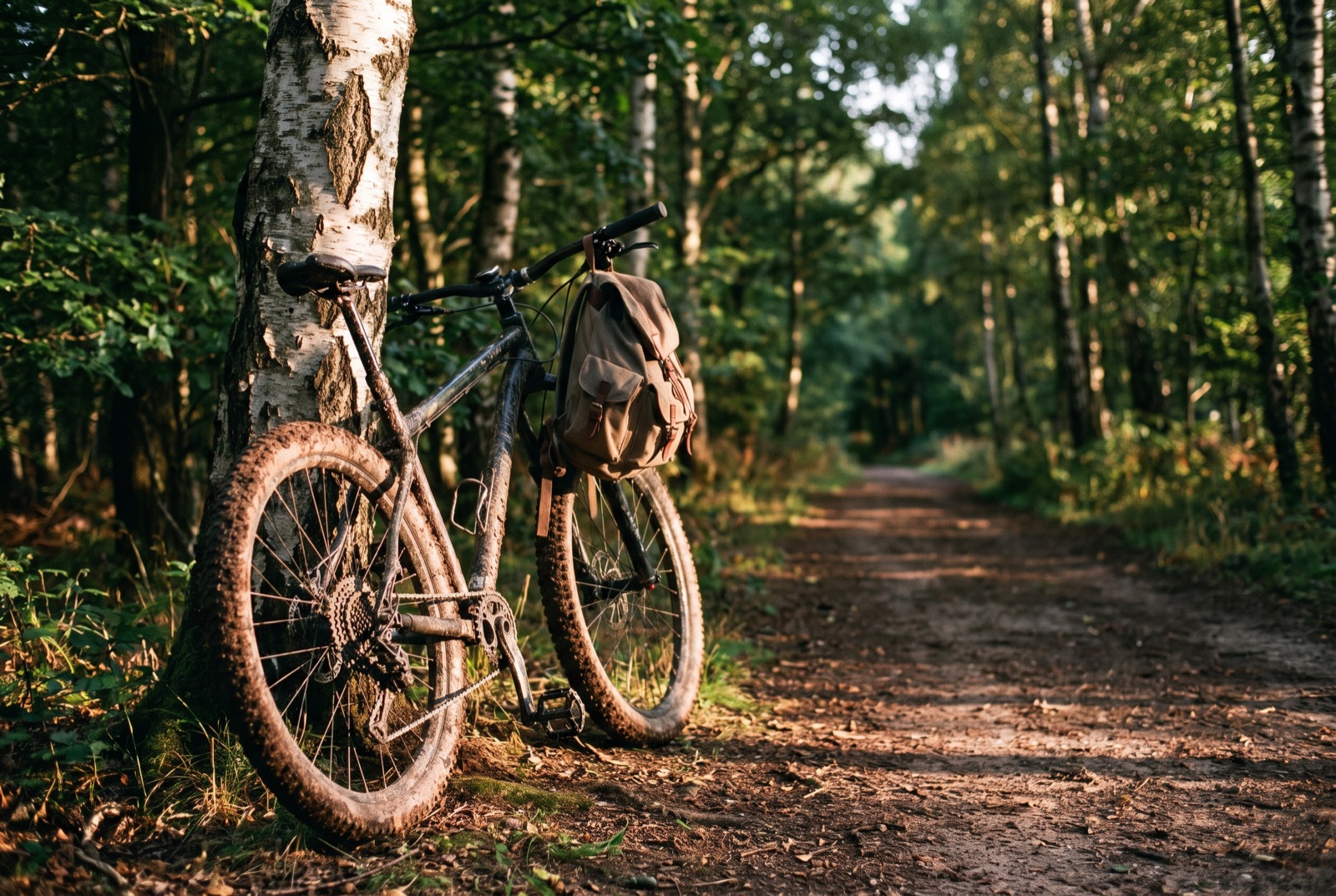
Bikes change the radius more than anything else you can pack. Comrie Croft is the shape of the thing — a mountain-bike trail network, a bike shop, a farm café to ride back to — so the day's radius belongs to them rather than to your car keys. Three Cliffs Bay is the other shape: a beach they can walk to and somewhere they can be sent for lunch.
Then the appetite, which parents underestimate by an almost comic margin. On the SACN energy requirements published by the British Nutrition Foundation, a boy of 15 to 18 has an estimated average requirement of 3,083 to 3,155 kcal a day — more than a man of 19 to 50, at 2,629 to 2,772. A girl of the same age needs about 2,390 to 2,462, against 2,103 to 2,175 for a woman. Those are baselines, before eight miles of coast path.
So cater for a fifth adult and then add walking. Buy for volume rather than variety, keep a snack box they do not have to ask permission to open, and let one meal in the week be bought rather than cooked.
The verdict: a cabin with a door beats a family tent at this age
Say it plainly, as the piece on under-threes says it: the door is the product. A cabin with a second bedroom solves privacy, charging and the late-night-and-late-morning mismatch in a single purchase, and the argument for four walls at this age is not comfort, it is a door that closes.
The cases where a tent still wins are specific rather than sentimental. A site they already like. A friend brought along. Two nights rather than seven. Or their own tent pitched next to yours, which is most of the cabin's benefit for the price of a takeaway.
That last one deserves the concession. Bringing a friend is the most effective intervention here and the one most parents resist, because it dilutes precisely the family time the trip was booked to produce. Weigh a diluted week against a poisoned one.
The trend reporting for 2026 keeps handing us the same tension. Sixty per cent of campers name traditional campfire activities and games as a key motivator; 77% say being in nature is enough on its own. Both describe what the parents want. The teenager's version of a good week is quieter, later, and a little further away from you. It is still camping, and they will come again.