Round a fire, the rules have to be short enough to say out loud once. That rules out most of what gets recommended, and it is why the games that have survived a hundred years of campfires are all built the same way: one sentence of setup, one thing you must not do, and a way for anyone to be out without minding much. Here are six, written out properly, because the moment you need them is the moment you have no signal.
The three things that decide whether a game works round a fire
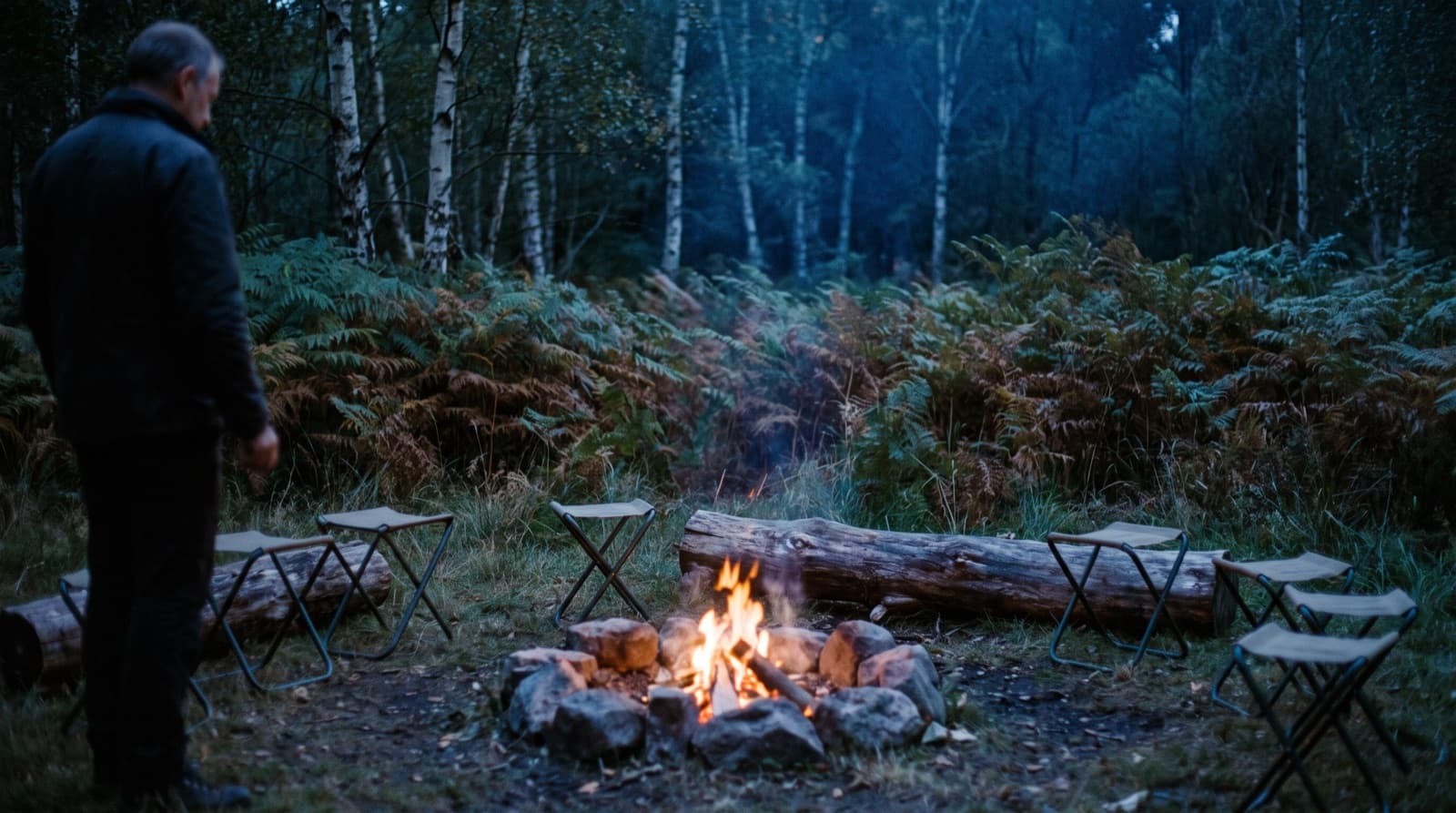
Everyone stays seated. That is not a preference, it is the constraint the fire imposes on everything else. Scouts UK's campfire guidance is a defined perimeter of logs or stones, at least a metre back from the flames, two metres or more for children who are not being closely supervised, never leaving a fire unattended, and moving the seating rather than the fire when the wind shifts. Lancashire Fire and Rescue adds the siting rule: build at least ten feet — about three metres — clear of tents, shelters, low branches and dry grass, and keep the fire small enough to step over. A running game belongs in the field before supper, not in this hour.
Nobody should have to see anything small. Firelight is generous on faces and useless on detail; it destroys anything that depends on reading a card, counting pips or telling red from brown. This is why the pocket games are a different article — the ones in the bag want a lantern and a flat surface, and a fire gives neither.
Mixed ages need games where a six-year-old takes a real turn rather than a handicapped one, which points at storytelling and shouting and away from deduction. So the test, applied to all six: can it be explained in one sentence, played sitting down, and abandoned without a loser.
Wink Murder, which is the one to open with
Everyone sits in a circle. One player is the detective and either leaves or shuts their eyes. While they are out, the murderer is chosen silently — a tap on the shoulder, or a card dealt to everybody with the ace of spades deciding. The detective returns and stands in the middle. The murderer kills by catching another player's eye and winking. A player who has been winked at counts silently to three, dies as theatrically as they wish, and is out. The detective gets three guesses; on the third wrong one, the murderer wins and reveals themselves.
It works round a fire because it is entirely a face game, and faces are the one thing firelight lights well.
It runs from about five upwards — a five-year-old cannot wink discreetly, which is funnier rather than worse. The ending is built in at three wrong guesses, but the real limit is that being the murderer is the prize, and the pleasure goes once everybody has had a turn. Three rounds, then something else.
Fortunately, Unfortunately, and the Minister's Cat
Fortunately, Unfortunately is a circle story told one sentence at a time, alternating between two fixed openings. The first player begins "Fortunately…" and says one sentence. The next says one sentence beginning "Unfortunately…". Round it goes, each player accepting what the last one did and making it better or worse. There is no winner, and the story ends when the group ends it. It is the only game here a three-year-old can join, and the only one you can start without anybody agreeing to play.
The Minister's Cat is Victorian and gentler than it looks. Going round the circle, each player describes the cat with an adjective beginning with A — "the minister's cat is an angry cat" — and no adjective may be used twice. When the circle is complete you move to B, then C, on through the alphabet. A player is out if they repeat an adjective or cannot produce one. Some households play it to a clapped rhythm, which is much harder.
Both are right when the group is tired but not ready for bed, because they lower the temperature of an evening rather than raise it. They also demonstrate the principle governing the rest of this article: a game with no winner ends cleanly, and a game with a winner needs a stopping point agreed before it begins.
Contact and Botticelli, for the older children
Contact needs at least three players — one wordmaster and two guessers — and is much better with five. The wordmaster thinks of a word and announces only its first letter. The guessers work by cluing aloud: an oblique clue aimed at some word beginning with the letters revealed so far. "It's what you do to a horse" might be aiming at BRIDLE. If another guesser thinks they have the clued word, they shout "Contact". The two count down from three and say their word at the same moment. If the words match, the wordmaster must reveal the next letter — unless the wordmaster has blocked it by saying the clued word out loud first, which they may do any time before the countdown ends. The guessers win by reaching the whole word. The published rules run longer, but that is enough to play.
Botticelli is the other one for this age group. The chooser thinks of a famous person and announces only the initial letter of their surname. Direct questions have to be earned. A guesser asks an indirect question — "Are you a Venetian painter?" — and if the chooser can name any person fitting both the letter and the description, the guesser earns nothing and play passes on. If the chooser is stumped, the guesser earns one direct yes-or-no question about the actual subject. The convention, and it matters, is that the subject must be at least as famous as Sandro Botticelli.
Both are for roughly ten and up, and both are ruined by one adult who is too good at them. Contact ends itself when the word falls. Botticelli does not, so agree a hard limit in advance: one round each, then bed.
Ghost, and the games for two or three
Ghost is for a small, quiet group, and works as well on a long walk as on a log. Players take turns adding a single letter to a growing fragment, which must always be the beginning of some real word — that is the whole rule. Whoever completes a valid word of four letters or more loses that round, as does anyone who adds a letter that cannot begin any word at all. Instead of adding a letter you may challenge the previous player to name the word they were building; if they can name a real one, you lose the round, and if they cannot, they do. Each round lost earns you a letter, in order: G, H, O, S, T. Collect all five and you are out.
Kim's Game needs objects but not equipment. Gather about fifteen things off the picnic table — a spoon, a bottle top, a peg — put them on a tray and uncover them for one minute. Then cover them and let everybody list what they remember. It comes from Kipling's 1901 novel Kim by way of Baden-Powell's Scouting Games, where the tray holds no more than about fifteen articles for the first few games.
Mafia, and an honest warning about it
Mafia needs six to twenty players plus a moderator who does not play. Roles are dealt silently — a few mafia, everybody else villagers — and the game alternates between two phases. At night everyone shuts their eyes; the moderator wakes the mafia, who agree on a victim without speaking, then sends them back to sleep. In the day phase the moderator announces who died, and the surviving players debate and vote one person out. Villagers win when every mafia member is gone; the mafia win when they equal or outnumber the villagers.
It was created by Dimitry Davidoff in the Psychology Department of Moscow State University in 1986 and first played in spring 1987, which explains how it feels to play.
Now the warning, because this is the game most likely to end a good evening badly. Mafia requires lying to your own family in the dark and being disbelieved by them, and under-tens enjoy neither half as much as the article recommending it assumes. It is excellent with teenagers and a mixed adult group, and a poor idea at nine at night with a seven-year-old. It needs a moderator willing to spend the whole game not playing, and the night phase leaves everybody with their eyes shut around an open fire — its own reason to insist nobody leaves their seat.
How to end a game before it ends itself
Announce the stopping point before the first round, not after the third. Every campfire game is good for about twenty minutes and every one of them is played for forty.
Three usable versions. The three-round rule, stated at the start, which suits Wink Murder and Mafia. The "one more and then we bank the fire" rule, which works because it attaches the ending to something visible rather than to an adult's patience. And ending on the best round rather than the last — when a round lands well, stop there, even if somebody has not had a turn, because the alternative is four flat rounds that overwrite it.
The 2026 camping-trend reporting has 60% of campers naming traditional campfire activities and games as a key motivator, about half planning a trip that recreates a childhood camping experience, and 77% saying just being in nature is enough, without structured programming. What survives is the good half hour, not the sour twenty minutes after it, and the only thing between the two is somebody saying "last one" while it is still going well.
None of this works without a fire to sit round, and a surprising number of sites do not allow one; Great Langdale does, with a near-year-round season. The rules on where and how a fire is permitted vary more than people expect, sometimes between two fields on the same estate.
Then bank the fire. Never leave it unattended, and never take anything that burns fuel into a tent or awning to finish it off — a cooling barbecue still produces carbon monoxide, which causes around fifty deaths a year in the UK and reaches lethal levels in an enclosed tent very quickly. Let the last game be Fortunately, Unfortunately, because it has no winner and therefore no argument. And if the weather takes the fire away entirely, that is the other article.