There is no committee. Nobody voted on any of it. And yet you can arrive on a field in Northumberland or in Pembrokeshire and know, without reading a word, that you do not walk between a stranger's tent and their view — while having no idea why you know it. Nearly all of it comes down to three things you can take from somebody on a campsite without ever touching them: their quiet, their sightline, and their space.
Most etiquette articles are twenty-five scoldings with no explanation, which is why nobody remembers them. Sort the same material by what is being protected and you can derive the rules you were never told, including in a country whose rules you have not read.
Sound: the eleven o'clock that is actually a ten o'clock
Quiet hours are real, written down, and the two big British clubs cannot agree on when they start. The Camping and Caravanning Club's rule 5.9 says no noise or movement of vehicles is permitted between 11pm and 7am. The Caravan and Motorhome Club sets the bar an hour earlier, asking that guests be mindful of noise at all times and in particular not disturb other guests after 10pm. Assume ten and be pleasantly surprised.
The detail almost everyone misses is that the first rule is not about voices. It says movement of vehicles: doors, handbrakes, boot lids, gravel, reversing beepers, awning poles going into the back of an estate at first light. A conversation at eleven carries thirty metres; a car door at six carries the entire field, and the 6am departure is the most antisocial legal act available to a British camper. Pack the night before and roll the car to the gate.
Generators are the divisive one, and the clubs reach the same place by opposite routes. The Caravan and Motorhome Club sets a flat window: don't run them between 6pm and 9am. The Camping and Caravanning Club requires staff permission, and can stop you if anyone is disturbed. Neither gives the number. Honda's EU22i is among the quietest portable inverter units sold, specified at 53–59 dB(A) with Eco-Throttle on at quarter load and around 56 dB at seven metres — conversation volume, from further away than your neighbour's groundsheet. A "super quiet" generator is a person talking, continuously, for as long as you leave it running.
Arrival windows exist for the same reason. C&CC bookings must not be arrived at before the stated time and in any event before 1pm, with pitches vacated by 12pm; CAMC arrivals are after 1pm, checkout midday. Not administrative preference — it compresses the loudest part of the day into the middle of it.
Sight: light, drones, and standing in someone's view
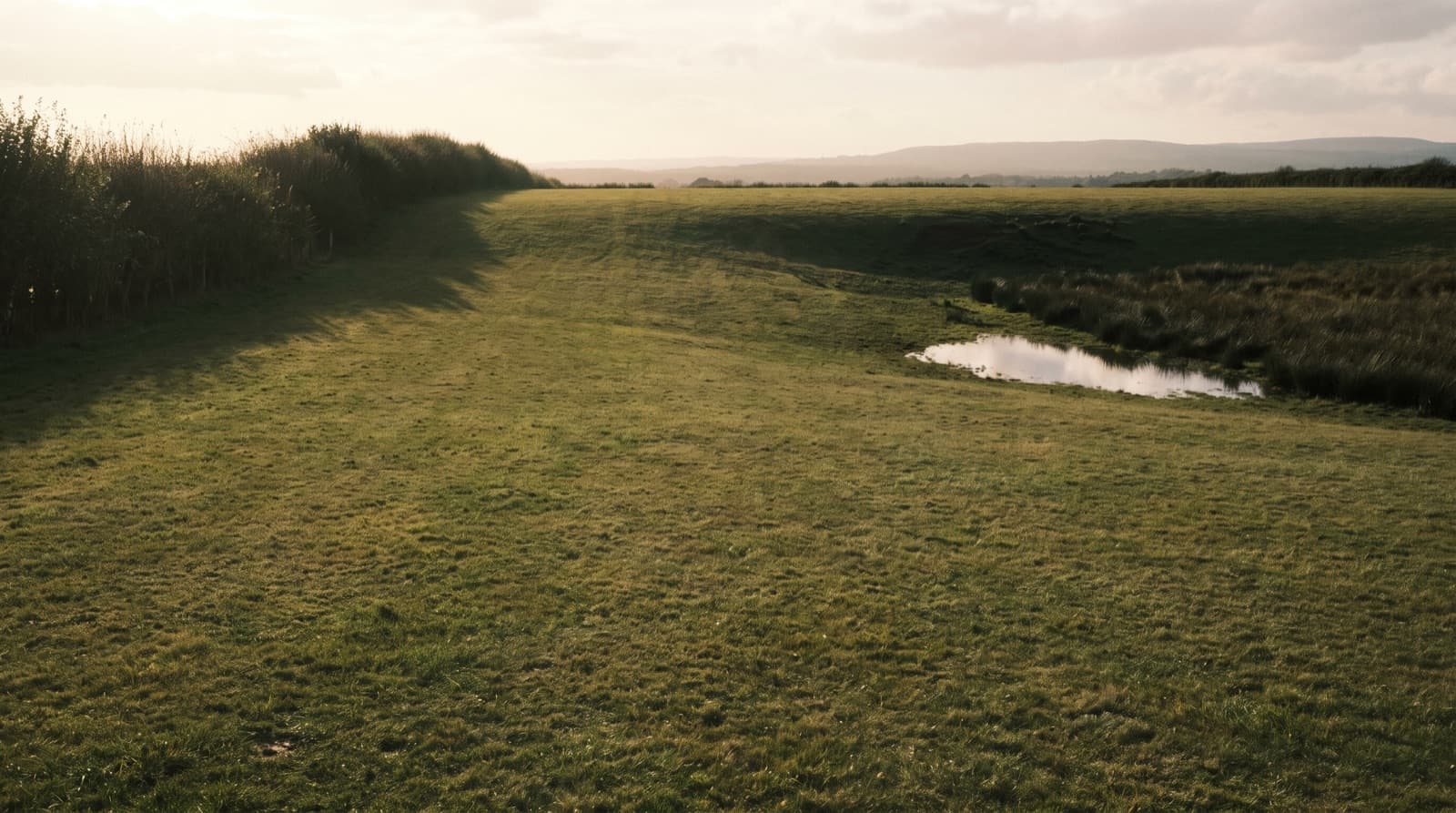
On a pitch with a view, everybody bought the same view. It produces the most silent fury and the fewest complaints to reception, because there is no rule number to cite. The windbreak, the awning, the van and the drying rack go on the side that does not take the view from the people behind you. Most of it is decided in the first ten minutes — choosing a pitch when you arrive covers the survey worth doing.
A pitch is a room without walls, and the shortest route to the toilet block is through somebody's kitchen. Walk round. Eleven seconds, and the most reliable marker of someone who has camped a lot.
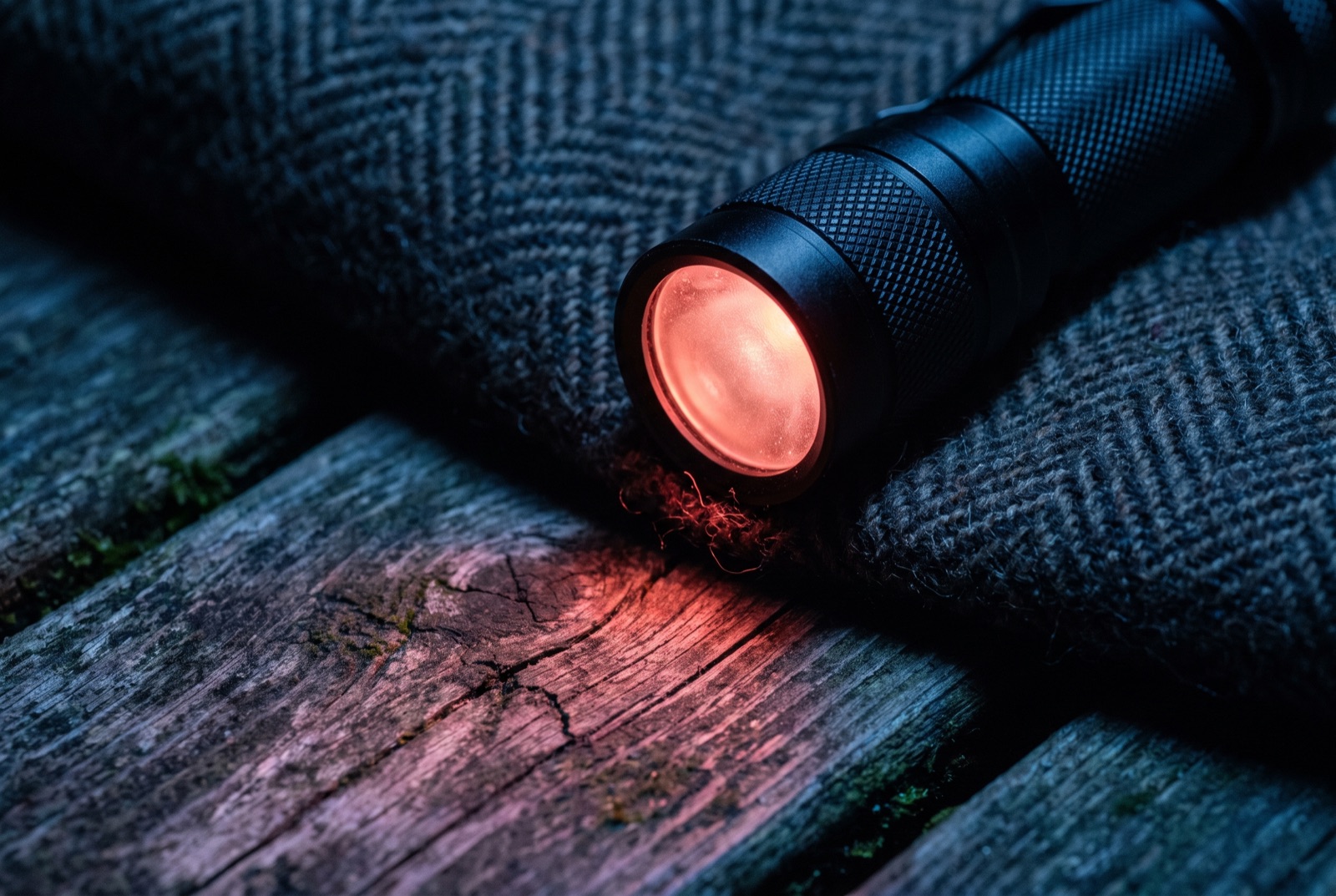
Head torches. The rule is not "don't use one", it is "don't turn round". Full dark adaptation depends on rhodopsin and takes roughly 20 to 40 minutes; a 200-lumen beam swung across a field at head height is full beam on an unlit lane, and it resets that clock for everyone whose eyes it crosses. Deep red light does not bleach rhodopsin, which is why red mode exists — the US National Park Service has the physiology. On a site chosen for the darkest skies in Britain, a white head torch is not a minor discourtesy. It is the reason the other forty people drove there.
With drones, the law arrives before the etiquette does. The CAA's drone code requires 50m horizontal separation from uninvolved people, at least 150m from residential, recreational, commercial and industrial areas, and a ceiling of 120m — and a campsite is a recreational area full of uninvolved people. Sub-250g and C0/C1 class drones have looser allowances, which is the exception people cite and then misapply. France is tighter still: 150m from built-up areas, and all recreational night flying prohibited outright, regardless of class, weight or lights.
Space: the six metres nobody tells you about
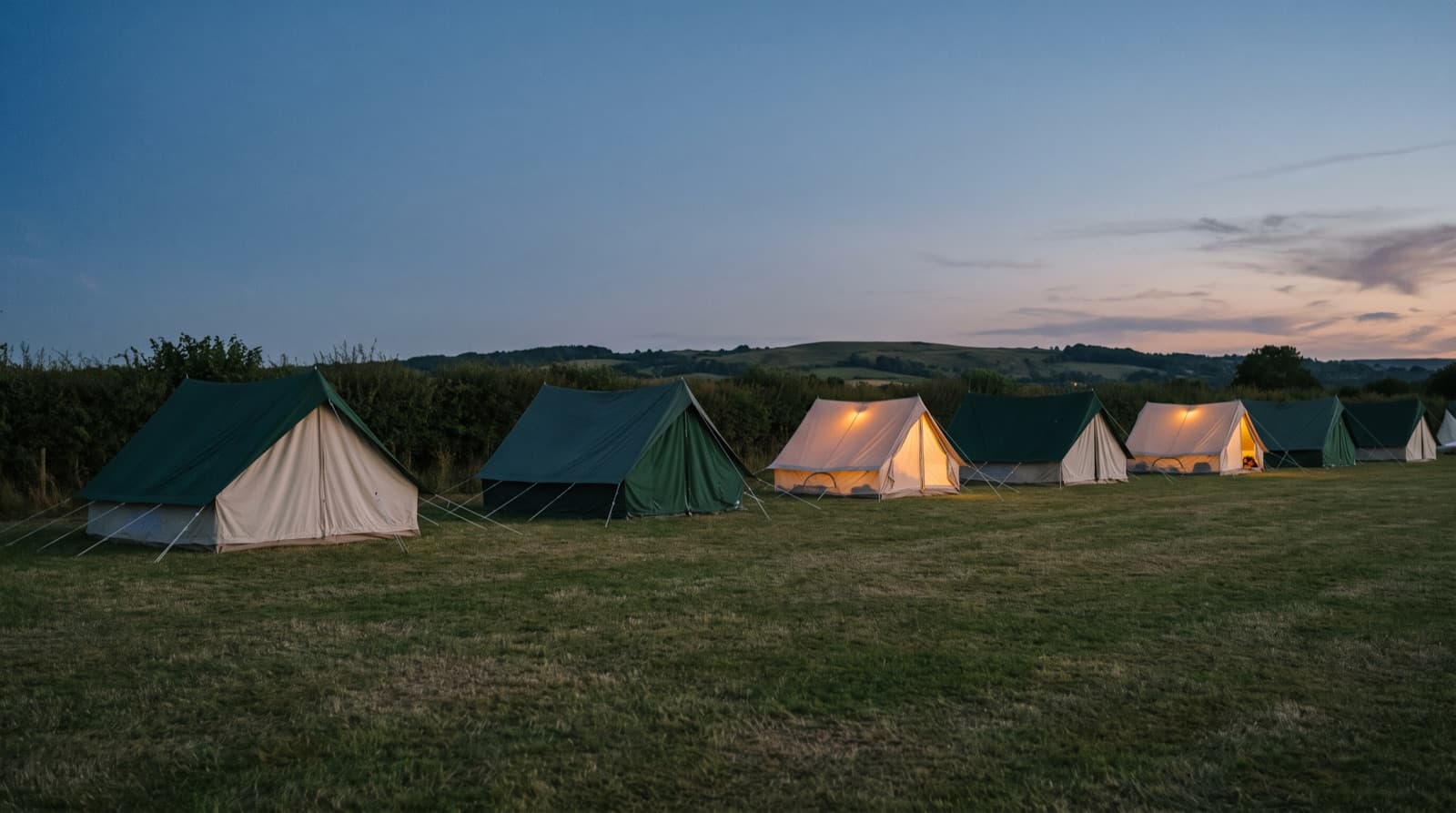
Here is the most useful fact in the article. The gaps between units are a fire regulation. The Camping and Caravanning Club puts it in one line at 4.1.1: all units, excluding guy ropes, should be 6 metres apart from any adjacent units in order to protect against fire.
It goes back further than the club. The Model Standards 1989, made under the Caravan Sites and Control of Development Act 1960, set a minimum separation of 5 metres between units of aluminium or similar fire performance — 3.5m at corners — and 6 metres where units have plywood or similar skins, or where types are mixed. That is why the warden moves you a metre and will not be drawn into a discussion. He is not being fussy about the row; he is complying with a licence condition.
The Caravan and Motorhome Club adds a second number that catches people out: at least 6 metres between the facing walls of adjacent caravans, motorhomes or trailer tents, and a minimum clear space of 3 metres between adjoining cars, awnings, tents and other items — windbreaks explicitly included — in any direction. Awnings wider than 2.5 metres may be refused where the pitch cannot take them, and note the difference between the two rules: guy ropes do not count, windbreaks do.
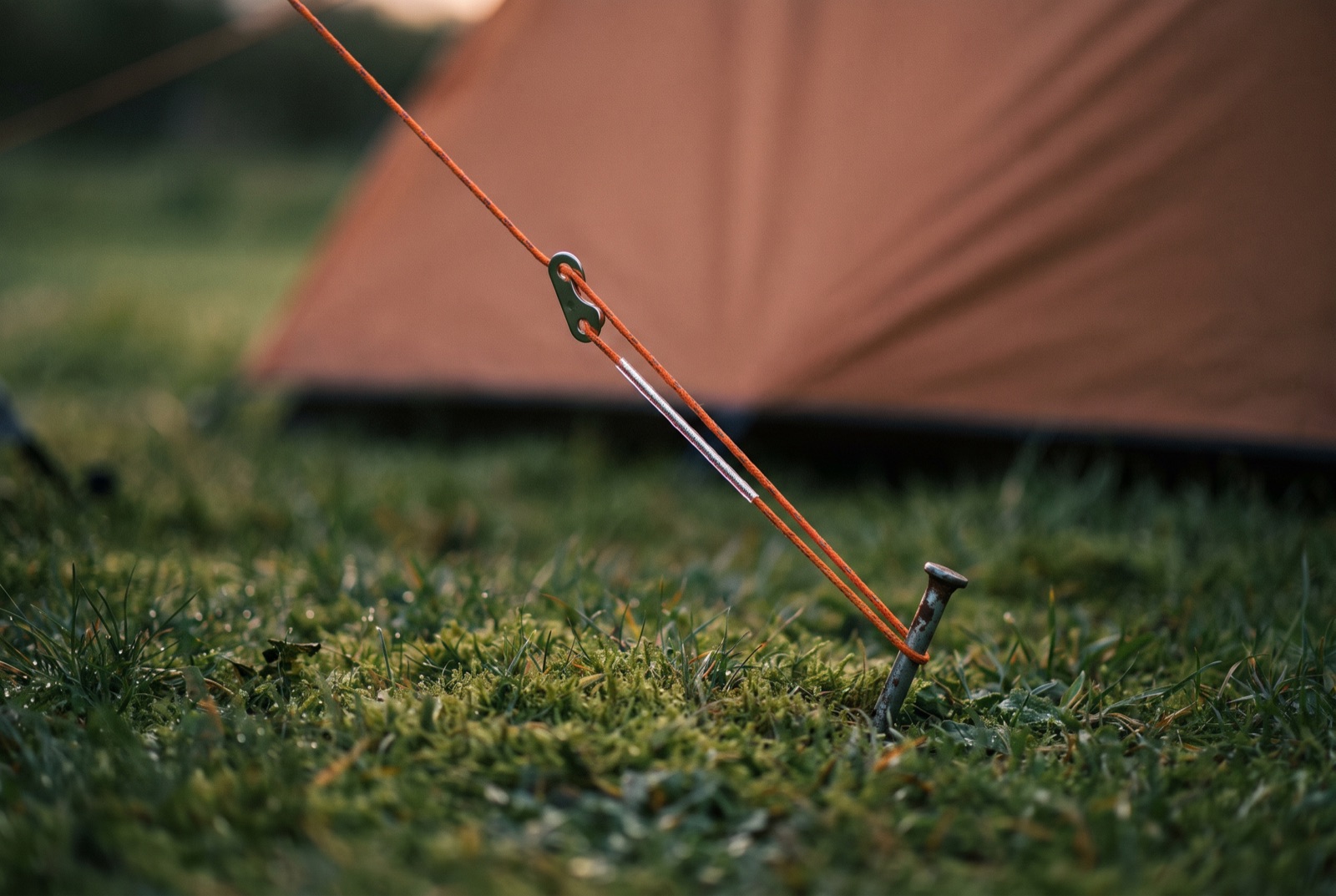
Then there is the guy-line walk. After dark on the first evening, do one slow lap of your own pitch and look at it the way a stranger walking to the toilets at 2am will meet it — at shin height, in the dark, at speed, with a bladder. Guy lines are the most common campsite injury and the easiest thing on the site to prevent. And a windbreak is a windbreak when it is between you and the wind; it becomes a garden fence at the point where it encloses a perimeter, which is a claim on land you have rented for two nights.
The shared rooms
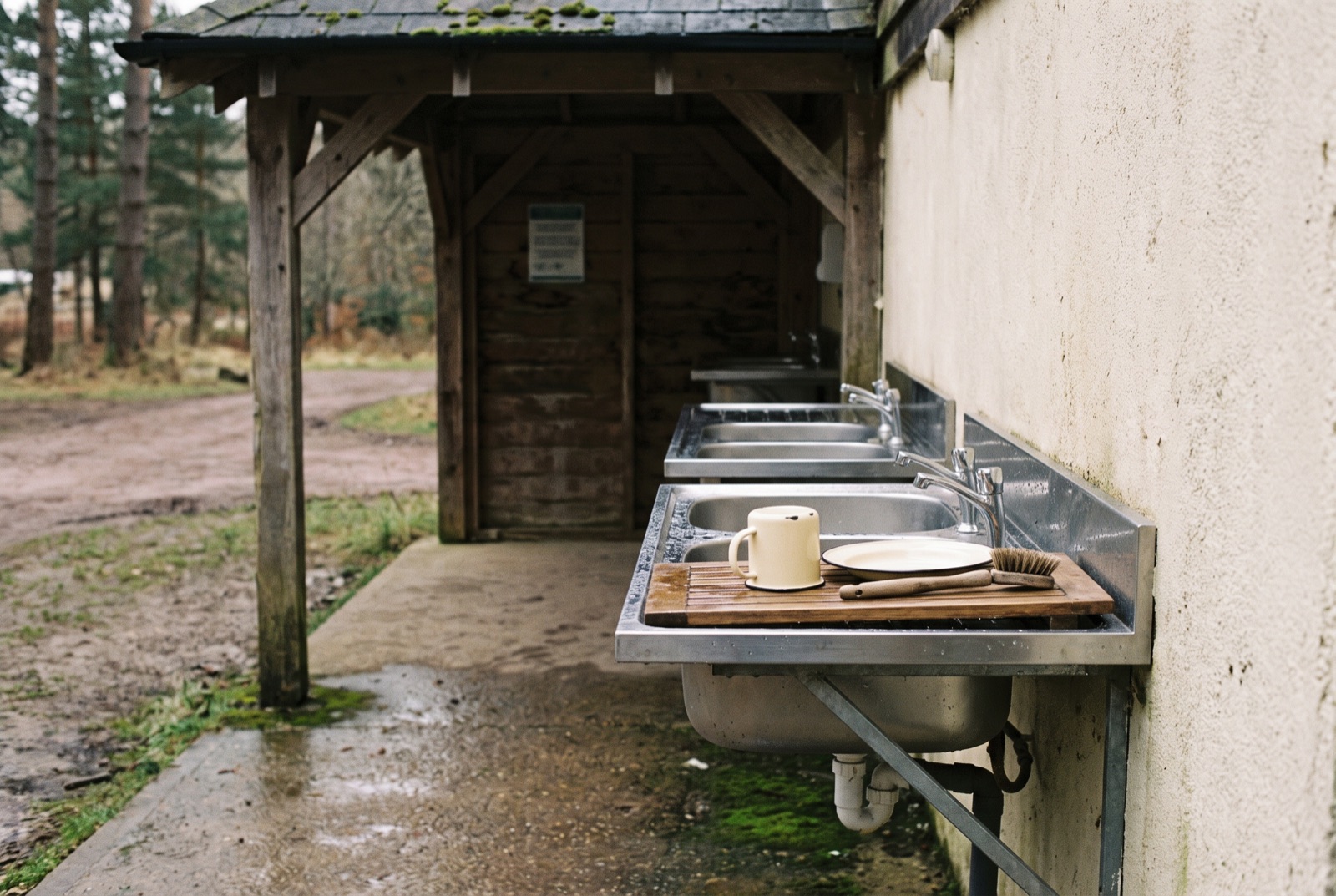
The washing-up sinks are a shared kitchen you do not own. Scrape into the bin before the tap goes on, because the plughole is not a bin. Do not leave a colander of pasta in the drainer while you go and find the salt. Do not do a family's worth of pans in the only sink at eight in the evening, the busiest moment on any campsite in Britain.
Showers run on the same logic: the constraint is the queue, not the water. Nobody minds a twenty-minute shower at eleven in the morning and everybody minds a five-minute one at eight. The rule that surprises people is the vehicle wash — a full-scale washdown of your outfit is not permitted unless there is a designated area, though a bucket is fine. Water use, and run-off. Grey water is where the actual arguments happen: the disposal point is not far away, the grass is not a soakaway, and a bowl tipped onto a pitch somebody will sleep on in a fortnight is what earns you a conversation with the warden.
Dogs, children, and other people's pitches
The dog lead length is a written number on both clubs' sites and it is two metres — shorter than the lead most people own, and much shorter than the extending one on the back seat. Dogs other than assistance dogs are barred from toilet blocks, reception, laundries and dishwashing areas. The unwritten half is that a dog barking in an empty awning is the loudest thing on any campsite, and its owner is the one person who cannot hear it. The questions that decide whether a dog is actually welcome are in camping and cabins with a dog.
Ball games are restricted by rule rather than by grumpiness. The Caravan and Motorhome Club states that no loose ball games are allowed on or near pitches; the Camping and Caravanning Club permits games in designated recreational areas. It sounds joyless until the first time a football hits your tent at half past seven. The workable translation is not "no ball games" but "not between the pitches", which on any site with a rec field costs a child a ninety-second walk.
Bikes and scooters belong on the site roads at a speed that assumes a toddler will emerge from between two caravans, because one will. Lights and reflective clothing after dark are a site rule rather than a parental preference, and no child under 18 may be left unaccompanied on site. Children take the blame for a lot of this, so: learning where a pitch ends is a skill, not a punishment, and it is the same skill the adults are using — they have simply had longer to make it invisible.
Almost nothing on a campsite is really a rule about manners. It is a rule about sound, or about sight, or about six metres somebody measured in 1989.
A British site, a French municipal, and a Scandinavian one
Britain is rule-dense, warden-led and enforced: the spacing is measured, the rules are published, and someone will check. Sociability is optional, which is a feature — you may spend a week two metres from a family, exchange nine words, and nobody will think you rude.
France is quieter on paper and looser in practice, with two hard edges. Quiet hours are generally 22:00 to 07:00, and the second edge is physical: many campsites close their gates at 22:00 or 22:30, after which no car comes in. You park outside, walk in, and collect it in the morning. The format worth understanding is the camping municipal, council-run, cheap and frequently on the best-sited land in the village. There is no water slide. There is a hedge, a tap and a view.
Scandinavia inherits its etiquette from the right to roam rather than from site rules, so the norms are about distance. Under Norway's allemannsretten, set out in the Outdoor Recreation Act of 1957, you may pitch on uncultivated land without asking — but not within 150 metres of the nearest inhabited house or cabin, and not for more than two nights in one spot without the landowner's permission. People raised on that arrive on a commercial site already assuming distance is the courtesy and that nobody owes anybody a conversation.
Three cultures that disagree about gates, wardens, hedges and whether it is acceptable to speak to your neighbours, and agree completely about sound, sight and space.
The one that isn't written down
The genuinely unwritten rule, the one no club has published and everybody follows, is that you acknowledge the people either side of you once, on the first evening — a nod, thirty seconds about the weather — and then leave them alone for the week. That exchange converts you from an unknown quantity into a neighbour, which is what makes the guy line, the early start and the barking dog forgivable rather than actionable.
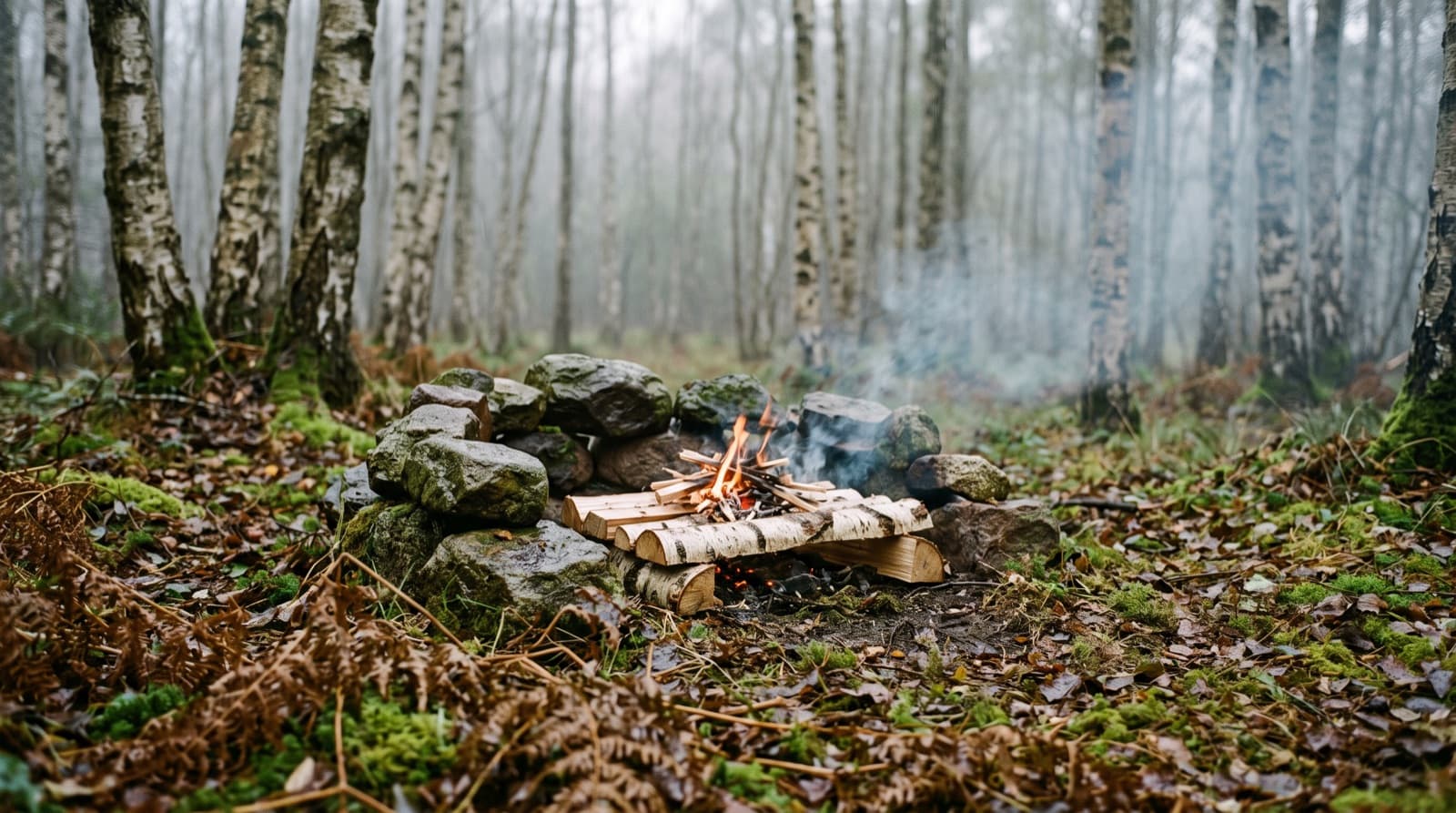
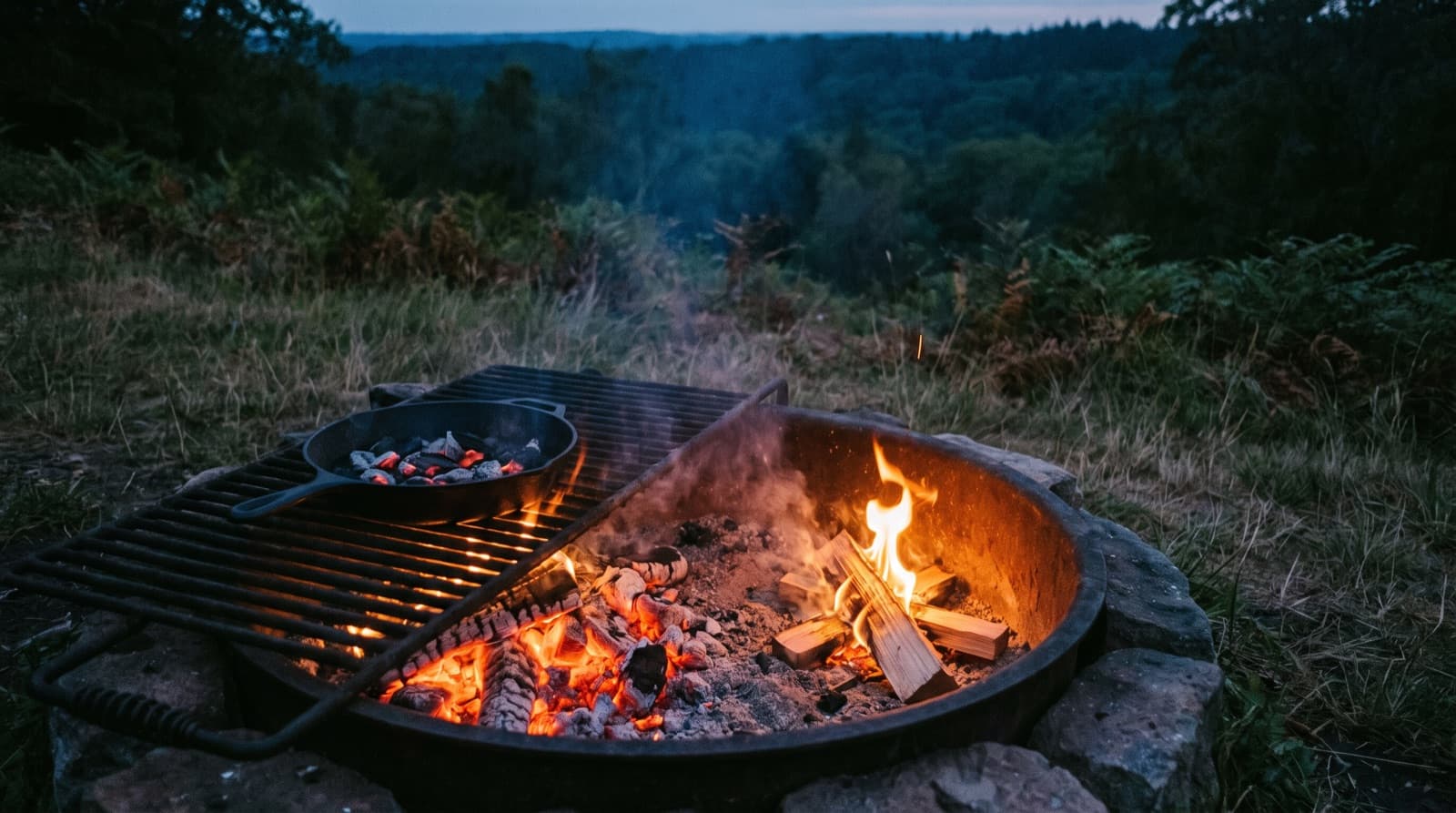
Fires are the loudest, brightest and most space-hungry thing on a field, which is why so few sites permit them — where you can actually have a campfire has the ones that do. Everything else is downstream of the nod.