Almost every campfire cooking failure has the same cause, and it is not the recipe. It is that the fire was still a fire when the food went on. Flame is for light, warmth and morale; the cooking is done by what is left of it forty-five minutes later, and the most useful skill in outdoor cookery is the ability to sit still and wait for that to happen.
None of this is any use if the site has a laminated sign about fire pits, and most British sites do — where you can actually have a campfire covers which ones don't. If the cooking is the point of the trip, start from the places that allow fires and work backwards.
Wait for the fire to stop being a fire
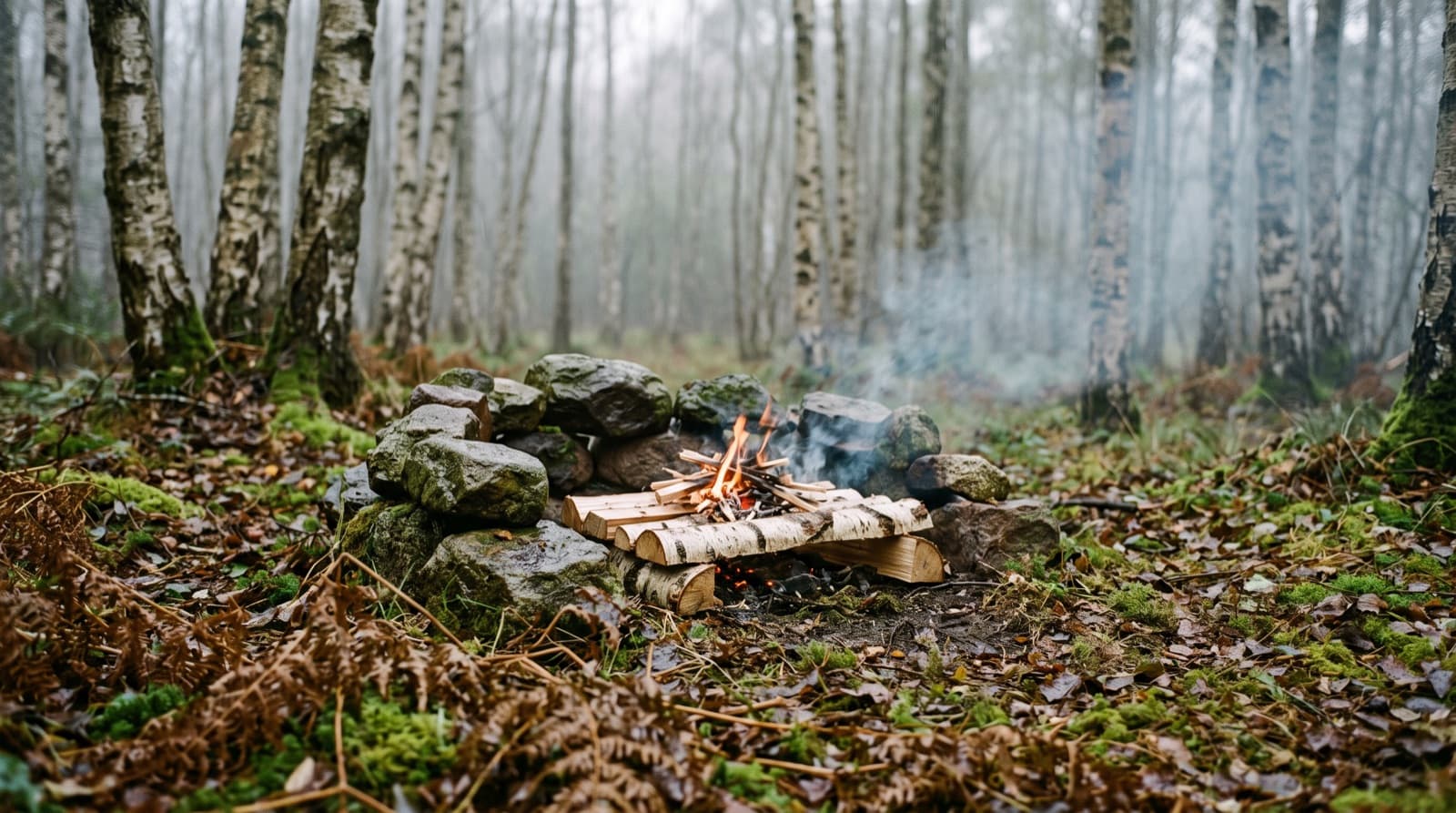
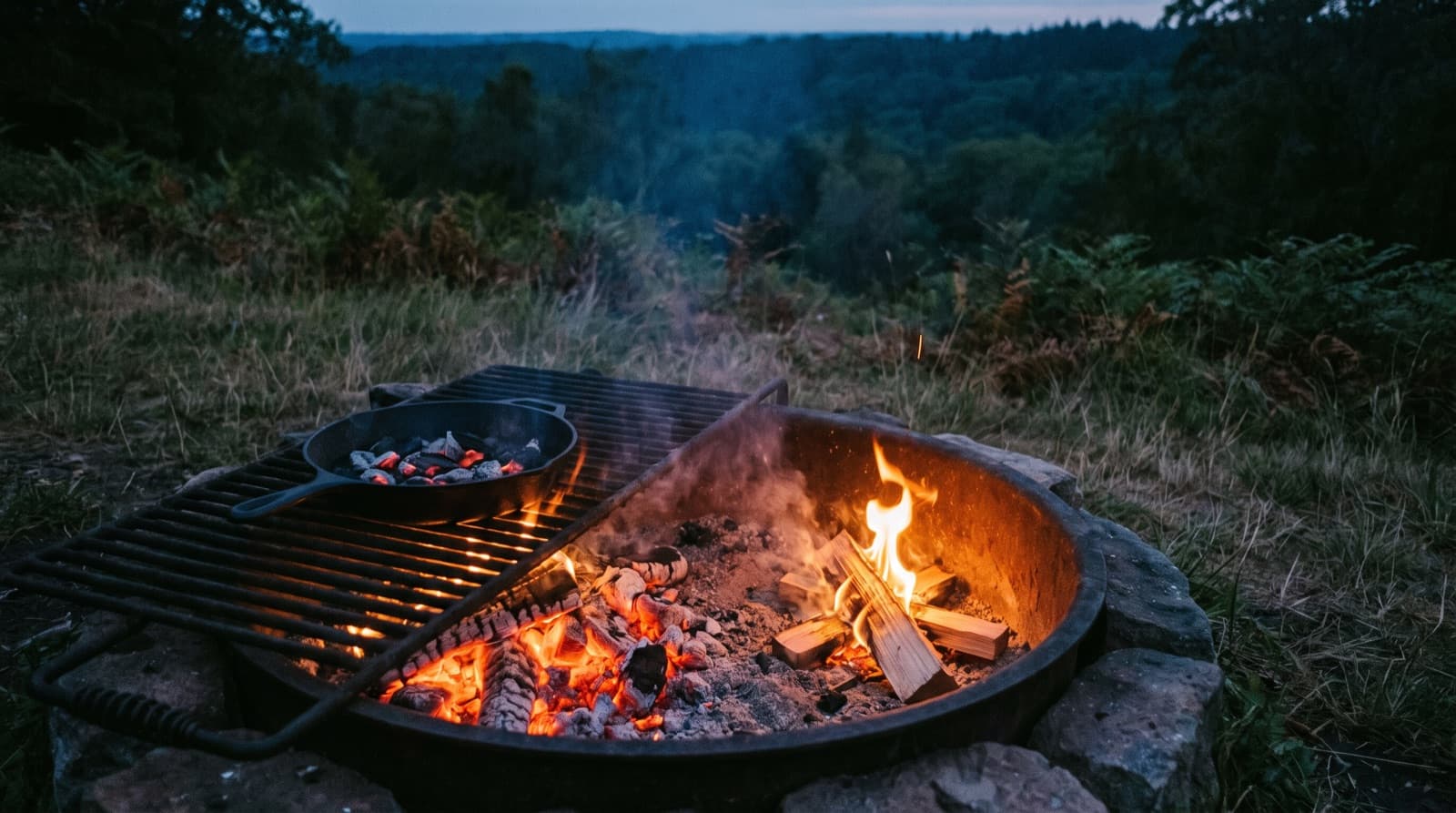
Flames are unsteady, directional, and far hotter at their tips than anywhere your food is likely to be. They move with the wind, surge when a log shifts, and deposit soot. A bed of glowing coals does none of that: steady radiant heat from a fixed distance, which is to say an oven. Build the fire 45 to 60 minutes before you cook and let it burn down.
The measurement you can take without equipment is the hand test, and Weber's numbers are the ones to memorise. Hold your palm five inches above the cooking grate — the height of a drinks can standing on it — and count until you have to pull away. Two to four seconds is high heat, 450–550°F. Five to seven seconds is medium, 350–450°F. Eight to ten seconds is low, 250–350°F. That is Weber's own scale, and it beats squinting at the colour of the coals.
The consequence is that the fire is lit before the beer, not after, which feels like officiousness at half past five when nobody is hungry and is the commonest fix for "the food was awful". You are not obliged to destroy the fire to cook on it, either: rake the mature embers to one side, keep a small feeder fire at the other, and move coals across as you need them.
The four heats, and what each is for
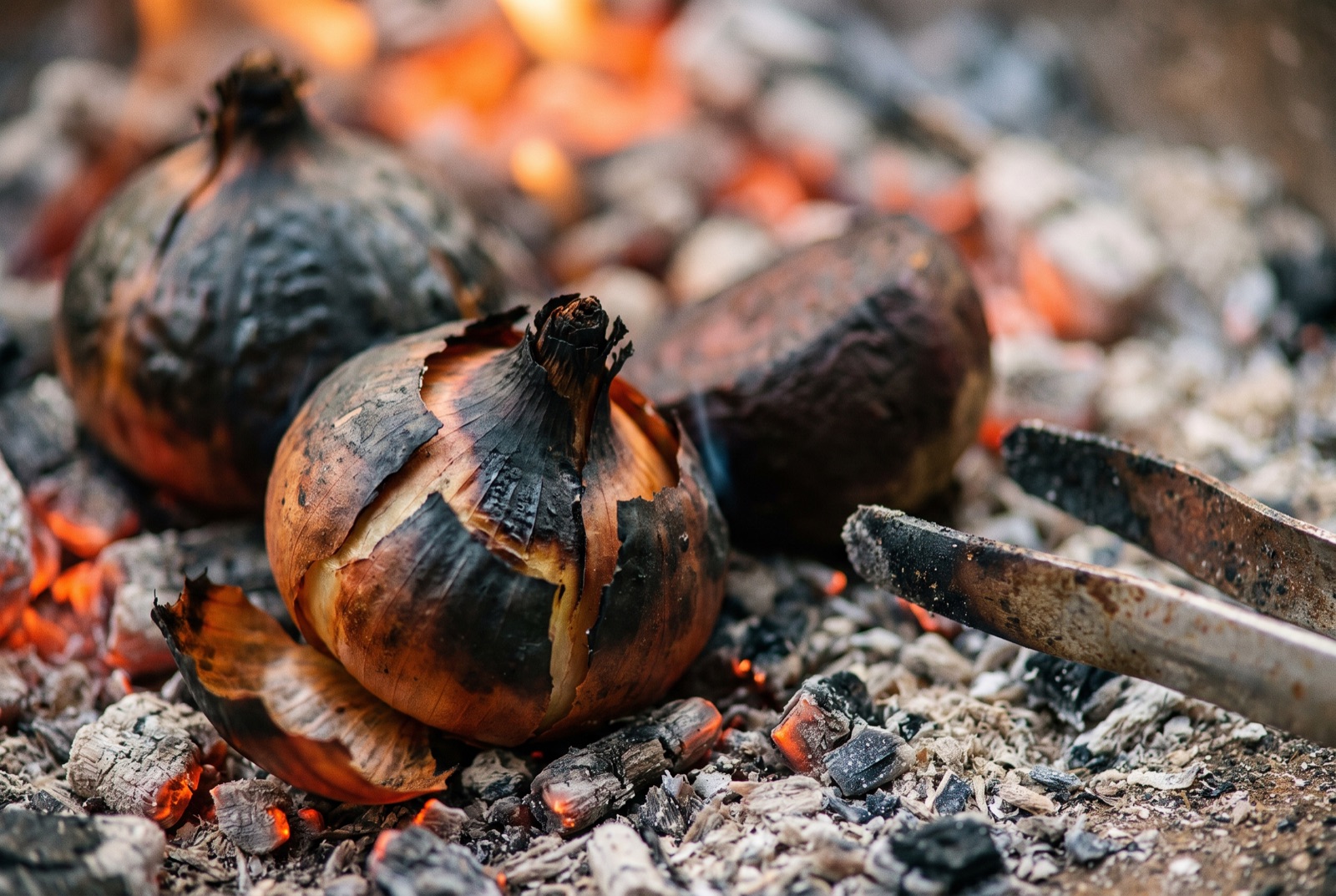
Direct on the embers. Whole roots and alliums go into the coals, skin treated as a sacrificial layer. No equipment, no pan, nothing to wash.
On a grate above the embers. The workhorse. Distance is your only temperature control, so a grate you can raise and lower is worth more than any pan; if it is fixed, you move coals underneath instead.
Sealed, in foil or a lidded pot. Steaming and braising: forgiving, hard to burn, and therefore the method for anyone feeding children who will want to eat at a moment unrelated to when the food is ready.
Contained, in a dutch oven with coals on the lid. The only campfire method that genuinely bakes, because heat comes from above as well as below. Everything else is grilling.
Foil, honestly
Heavy-duty foil, doubled, with a proper folded seam rather than a scrunch. The packet sits on the coals and out of direct flame; 20 to 40 minutes depending on the heat of the coals and how thickly things are cut, turned every five minutes.
It goes wrong in three predictable ways. Single-layer foil burns through and the contents go into the ash. An over-full packet steams rather than roasts. And everything inside must be cut to cook in the same time, which is the one people ignore: potato in half-centimetre slices and carrot in batons finish together, a whole new potato and a courgette do not. Add fat and a splash of liquid, or you have built a sealed bag of dry heat.
The honest caveat is that foil is a consumable and every scrap comes home with you, sooty and unrecyclable. A reusable enamel dish with a foil lid does the same job with a tenth of the waste.
The dish worth learning is chorizo, new potatoes and red onion: potatoes halved, chorizo sliced thickly, onion quartered, a good glug of oil. Double-wrap, seal, 30 minutes on medium coals turning every five. You want potato that gives completely to a knife and a puddle of orange oil in the bottom.
Cast iron, and the dutch oven arithmetic
The persistent myth is that cast iron spreads heat well. It does not. Cast iron is a poor conductor and a superb retainer: heat moves slowly and unevenly across the surface, which is why a 12-inch skillet on a small heat source gives a blazing centre and a cool rim. The fix is a long, boring preheat, not a bigger fire. In exchange you get a pan that will not drop temperature when four cold chicken thighs hit it — on a fire, where there is no dial to turn up, worth more than conductivity.
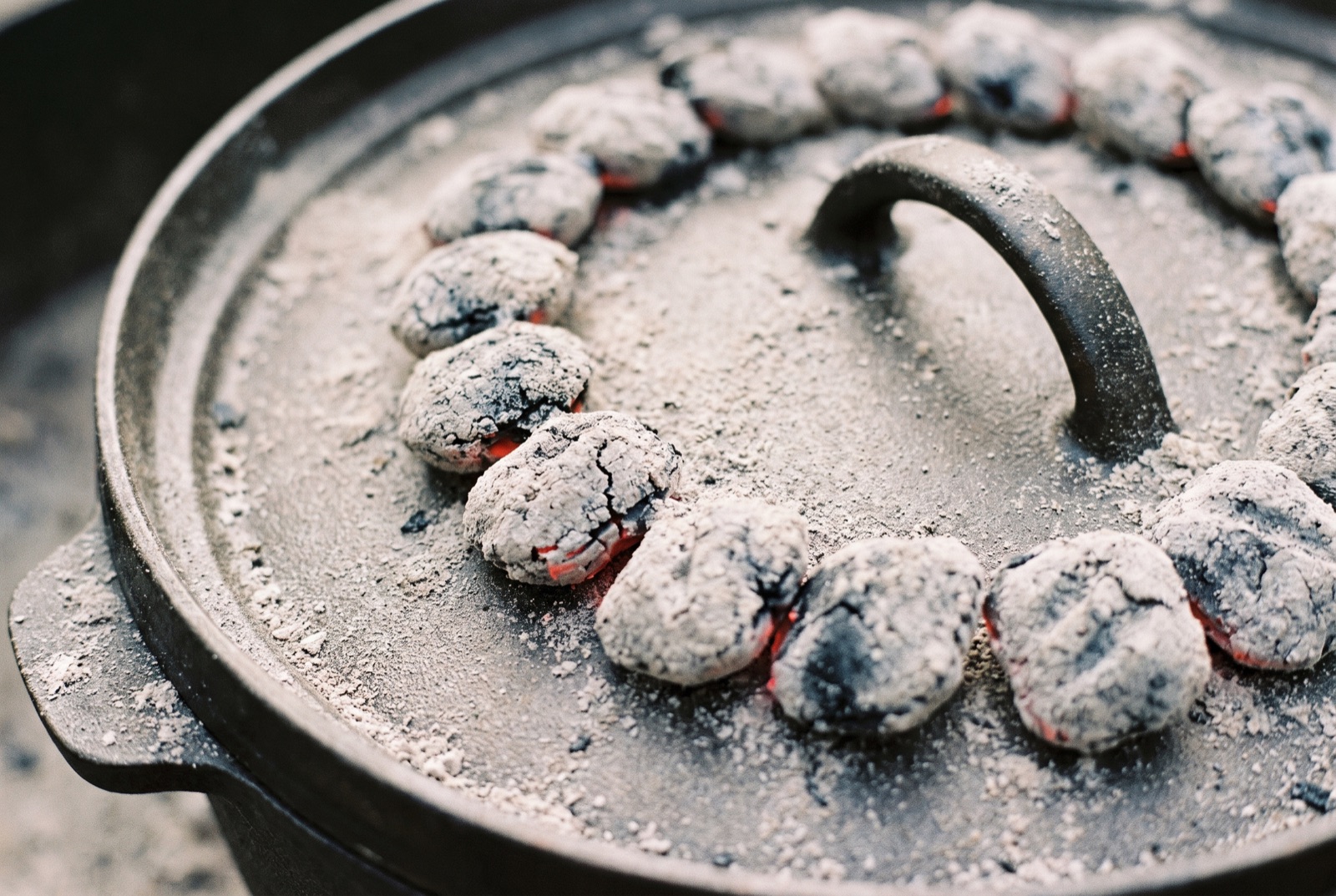
The camp dutch oven is where the arithmetic starts. The widely quoted rule of three says briquettes equal to the oven's diameter plus three on the lid, and the diameter minus three underneath, giving approximately 350°F. For a 12-inch oven that is 15 on top and 9 below.
The published sources do not agree. Scout Life's chart gives 17 on top and 8 underneath for 350°F in the same 12-inch oven, and 19 and 10 for 400°F — close to the rule of three, but not the same numbers. Both are starting points, and wind, ground temperature and altitude will move either. The same disagreement runs through the adjustment figures: one common rule is that roughly two briquettes move you 25°F either way, another widely used figure is about 10°F per briquette. Pick whichever you like, then trust the lid rather than the arithmetic.
The ratios by task are more reliable than the absolute counts, and Lodge's own guidance is the clearest version: to bake, three times as many coals on the lid as underneath; to roast, an even split; to boil, stew or fry, all of them underneath and none on the lid. To kill the hot spot, lift and rotate the oven a quarter turn every 10 to 15 minutes, then rotate the lid a quarter turn the other way.
The trade-off is weight. A 12-inch camp dutch oven is a car-camping and cabin item; nobody is carrying one to a hike-in pitch. The woodland pitches at Comrie Croft are car-free but the barrows are not far, which is roughly the limit of the concept.
Four things worth cooking
Ember-roasted onions and beetroot. Whole and unpeeled, nestled directly into the embers, roughly 30 to 60 minutes, turned occasionally, until a knife goes in with no resistance. The blackened skin is discarded; what is underneath has gone sweet and dense in a way an oven does not manage. It is the best argument in the article for the ember method, because it needs no equipment at all.
The fire is not the cooker. The fire is what you have to destroy in order to get a cooker.
Whole trout or mackerel. In foil, placed directly in hot coals, 7 to 10 minutes. On a grate roughly 12 inches above the coals, 15 to 20 minutes, turned once. Done when the flesh is opaque and firm and the skin peels away from flesh that flakes.
Dutch oven bread, or a fruit cobbler. The showpiece, and the reason to carry the weight: 350°F, which on a 12-inch oven means the coal counts above, and the quarter-turn every 10 to 15 minutes. Bread is done when it sounds hollow underneath, a cobbler when the topping is set and the fruit bubbles up round the edge.
Bannock on a stick. One cup of flour, a tablespoon of baking powder, a teaspoon each of sugar and salt, water until you have a stiff dough. No proving. Twist a rope of it round a green stick and hold it above the coals rather than in them — roughly 20 minutes, turning — because in the flames it burns outside and stays raw in the middle. The children's job, and the thing that survives a wet week. Kudhva has fire pits at the hideouts and no mains electricity, which is the version of this where the fire does the work rather than being a feature.
The cabin case: a wood-burner and a bad kitchen
A large share of the people reading this are not on a field at all. They are in a cabin whose kitchen photograph was more flattering than the kitchen, with a two-ring hob and a wood-burner — and the wood-burner is the better appliance.
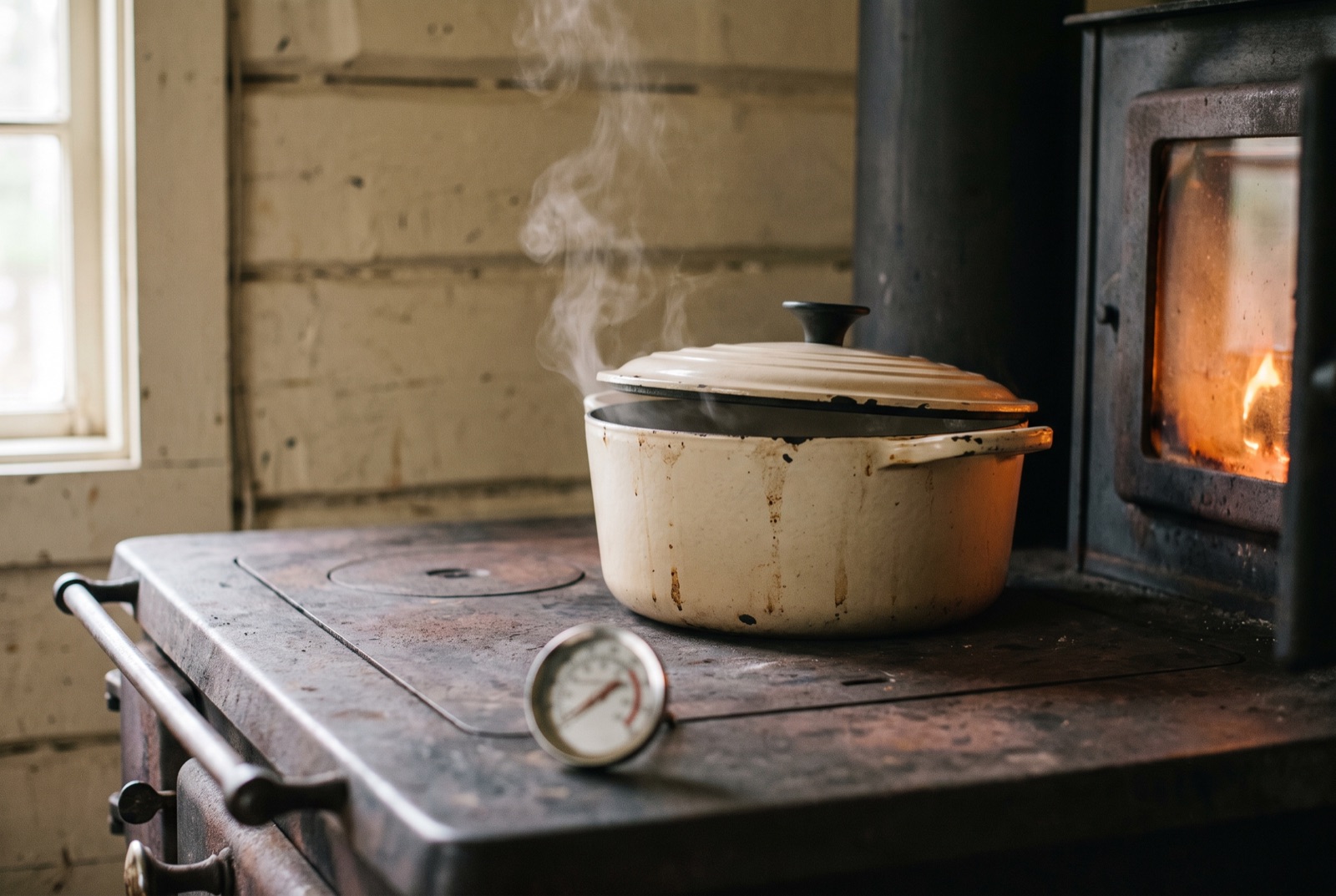
Treat the stove top as a hob with zones you did not choose. The hottest area sits directly over the firebox and the temperature falls away towards the flue. A magnetic surface thermometer costs about twelve pounds and turns that from guesswork into cooking. Most stoves run efficiently with a stovetop surface temperature of roughly 200–350°C: below that you are producing smoke and depositing creosote in the chimney, which is a genuine fire risk, and above it you are wasting fuel and can damage the stove. Condar's guidance sets it out properly.
What works is anything wanting long, low, unattended heat — a braise, a stew, a pot of rice taken off and left with the lid on. What does not is anything requiring a fast change of temperature, because you cannot take a wood-burner off the heat. Two rules are not negotiable: do not open the stove door to cook on the embers indoors, and do not put a pan on a stove whose manufacturer specifies it as convection-only.
The cabin corollary is to bring one good heavy pan rather than trusting the kitchen. It is the highest-value item in the car.
What actually has to be hot
The Food Standards Agency's position is admirably specific: the middle of the food should reach 70°C for two minutes, or an equivalent combination — 60°C for 45 minutes, 65°C for 10 minutes, 75°C for 30 seconds, or 80°C for 6 seconds. Measuring that accurately needs a clean food thermometer, and the FSA says so itself.
Which meats it applies to is the part people get wrong in both directions. Poultry and pork can carry bacteria all the way through the meat, and so can anything minced or skewered through — burgers, sausages, kebabs — all of which must be cooked thoroughly. Whole cuts of beef and lamb carry bacteria on the surface only, and may be served pink. Fish is done when the flesh turns opaque and separates easily.
A probe thermometer costs about ten pounds and is what makes campfire cooking safe rather than hopeful. It also ends the argument about whether the chicken is ready. The rest is cross-contamination, which outdoors means one board, no sink and a coolbox: raw meat sealed at the bottom of the box, one side of the board for raw and the other for cooked with a mark on the edge, and hands washed with water you brought.
All of it assumes you got the fire lit, which in a British August is not a given — lighting a fire in the wet is the companion piece. None of the difference between good and bad campfire food is in the ingredients. It is in whether you were prepared to sit and watch a fire go out.