The wet is not the problem. Wet wood is the problem, and those are not the same thing. It can be raining hard, and have been raining for three days, and there will still be dry fuel within thirty feet of you — because water takes a surprisingly long time to get into the middle of anything, and most of what you need has a middle.
Almost every article on the subject sells you a gadget — a plasma lighter, a tin of gel, a match that burns underwater — and none of it saves you. The failure was never the spark. It was that the fire was built on soaked ground out of fuel picked up off soaked ground.
One thing first: on most British sites the answer is no. Where you can actually have a campfire covers who permits them and why permission goes in a dry August; if a fire is the reason for the trip, book from the places that allow them. Everything below assumes a site that has said yes.
Where the dry wood is when everything is wet
Rain wets surfaces quickly and interiors slowly. That is the whole principle: the fuel you want is standing up, inside something else, or full of resin. Never pick wood up off the ground. Leaf litter is a sponge, and a branch that has lain in it a fortnight is wet to the core.
Standing deadwood is the primary source — a branch that has died but not yet fallen and is still attached, or a dead sapling still on its feet. Even after heavy rain the centre of standing dead wood is likely to be dry, and the field test settles it in a second: look for sticks that snap easily, and if they bend or splinter there is too much moisture in them. The dead lower branches of conifers are the same idea with a roof over them, sheltered by the canopy all storm.
The bag of logs at the site gate looks soaked, and the wet on it is surface wet. Under the Air Quality (Domestic Solid Fuels Standards) (England) Regulations 2020, in force from May 2021, wood sold in volumes up to 2m³ must be certified Ready to Burn with a moisture content below 20% — legally required to be dry in the middle. Water is a heat thief: every drop in the cell walls must be raised to 100°C and driven off as steam before the fibre can ignite, and wood at 30% moisture content yields roughly 25–30% fewer usable BTUs than wood at 15%. Baton the log into quarters and you have four faces that have never met rain.
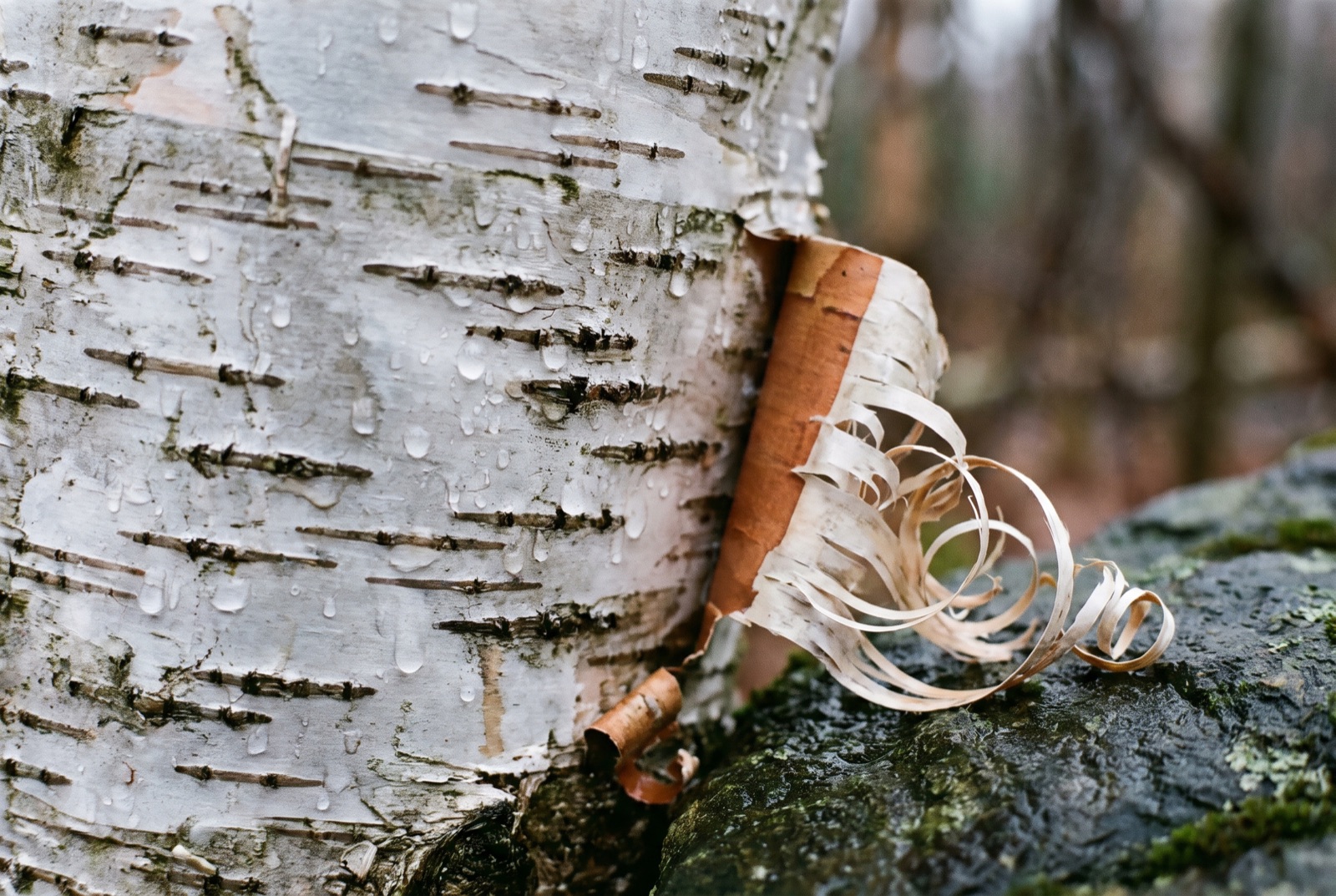
Two materials break the rule outright. Birch bark lights wet: the fine white outer layer is loaded with betulin, a water-resistant terpene in the bark's oils, and a piece the size of a coin scraped into shavings takes a ferro rod spark even damp. Take what is already peeling, never what is on a living tree. Fatwood is the other — resin-saturated deadwood from conifers, typically the stump or the inch or so of a dead branch where it met the living trunk, so loaded with resin that it does not absorb water the way ordinary wood does.
Tinder, kindling, fuel — and why people skip the middle one
Define the three tiers by what they do, not by how thick they are. Tinder takes a spark. Kindling turns a flame into a fire. Fuel turns a fire into heat. The near-universal error is to do the first and the third and skip the second — a beautiful nest of dry grass, one match, and then a log. Gather three times the kindling you think you need, then gather it again, and do not strike anything until the kindling pile is visibly larger by volume than the tinder pile.
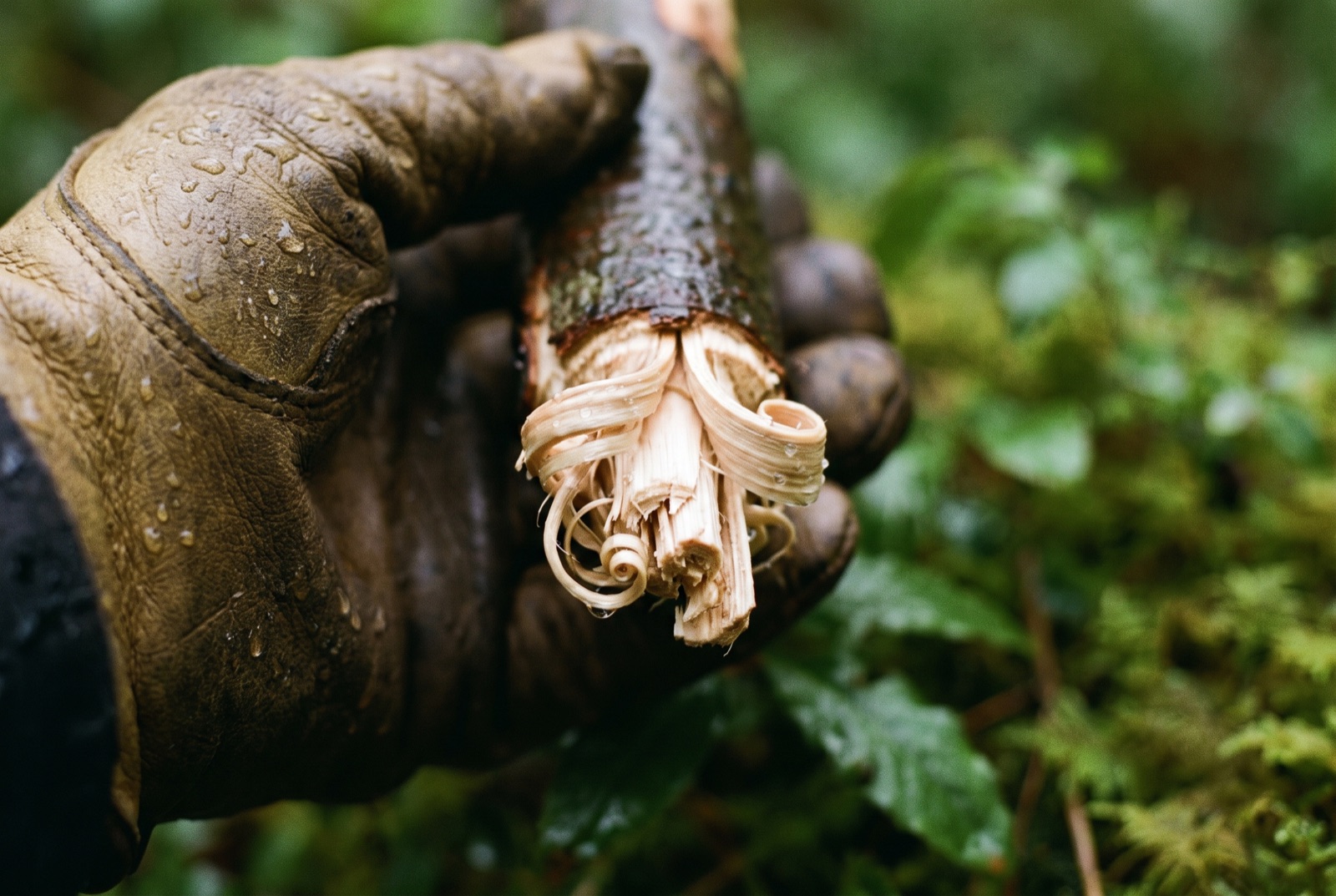
The feather stick is the wet-weather answer, and it rewards precision. Select dead, dry, standing wood roughly 5–7cm in diameter, straight-grained and free of knots; cut it into 30–35cm sections; baton your knife through each to split it into quarters, or eighths if the stock is thicker, exposing the dry interior. Then shave curls over about 180° of one face, starting and finishing each curl at the same point so the feathers bunch at the base rather than scattering down the length. Paul Kirtley's number is at least three such sections to get a fire established.
Tinder brought from home is not cheating. A cotton wool ball worked through with petroleum jelly burns for roughly six to nine minutes, which is long enough to dry and light kindling that would never have caught off a match. The jelly does not burn; it melts, and the cotton wicks it like a candle. Pull the ball open to expose the dry inner fibres before you strike, or the spark skates off the greased surface.
The ground is the enemy
Wet ground does two things to you, both quiet enough that you will blame the wood. It wicks moisture up into the tinder before the tinder has caught, and it swallows the heat you are accumulating into the soil. The fix is a platform, thicker than instinct suggests: on damp ground, a base of sticks roughly 50mm deep before anything else; on genuinely wet or marshy ground, a raft of thick green logs laid parallel, green rather than seasoned precisely because green will not burn through under you halfway through the evening.
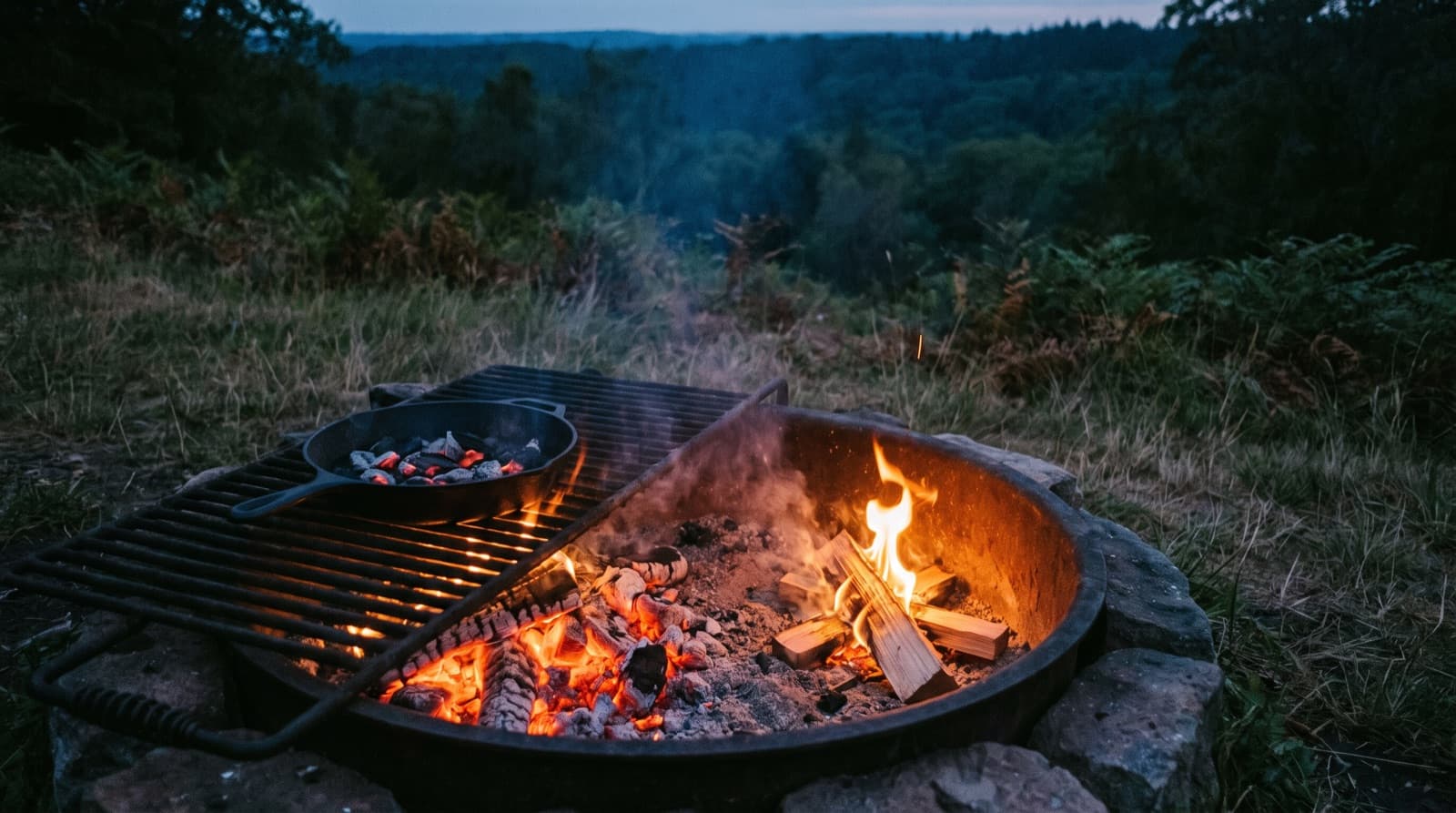
For the extreme case there is the raised hearth, or altar fire: a hollow tower of logs at least 18 inches high, decked with green logs and topped with at least 9 inches of the driest mineral soil available, with the fire built on that. It takes half an hour and works in a bog. It is also unnecessary wherever a site has laid a pit or a ring — and a site that permits fires has thought harder about drainage than you will at seven in the evening in the rain.
One thing not to build it from: stones out of a stream bed, or off the wet margin of a river. Water-tumbled stones are porous and hold water in internal cavities; heated in a fire, that water flashes to steam, expands roughly 1,700-fold, and the stone can fail explosively without warning. Dense dry stone — granite, slate — or the ring the site already laid.
Three structures, and when each is right
A teepee is the fastest thing to flame, because a cone of sticks is a chimney. It is right when you want light and heat immediately and will feed it constantly, and its weakness is that it collapses, usually onto the tinder.
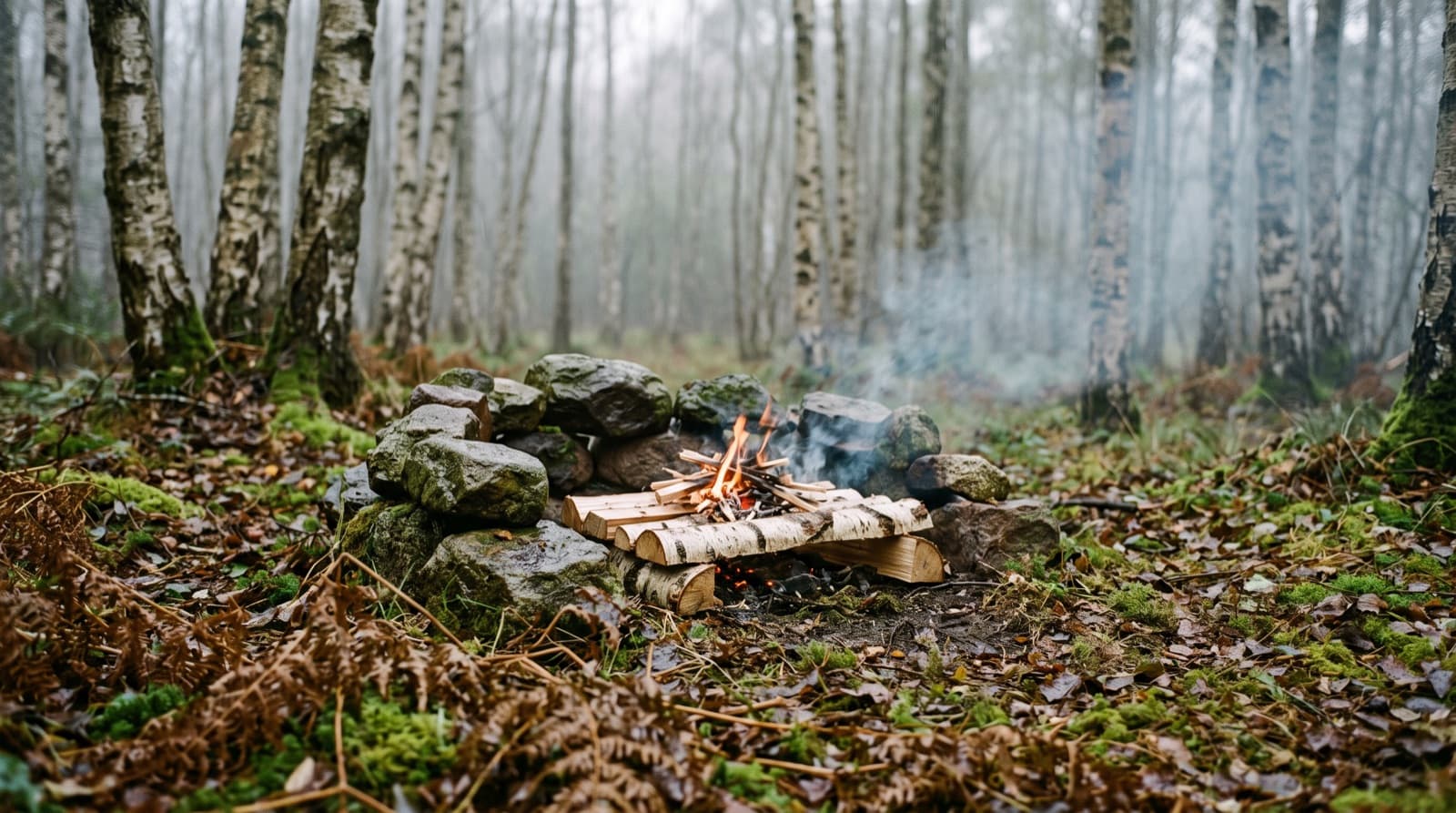
The lean-to is the wet-weather default, and the version built against a split log is the one to learn. Lay a substantial split log along the windward side, flat face inward, and build tinder and kindling against it in a slope; the log shields them from wind and rain and reflects heat back into them, drying as it works. The wild-feel pitches at Graig Wen sit above an estuary where the wind is doing something most evenings, which is where you learn that a lean-to beats a teepee.
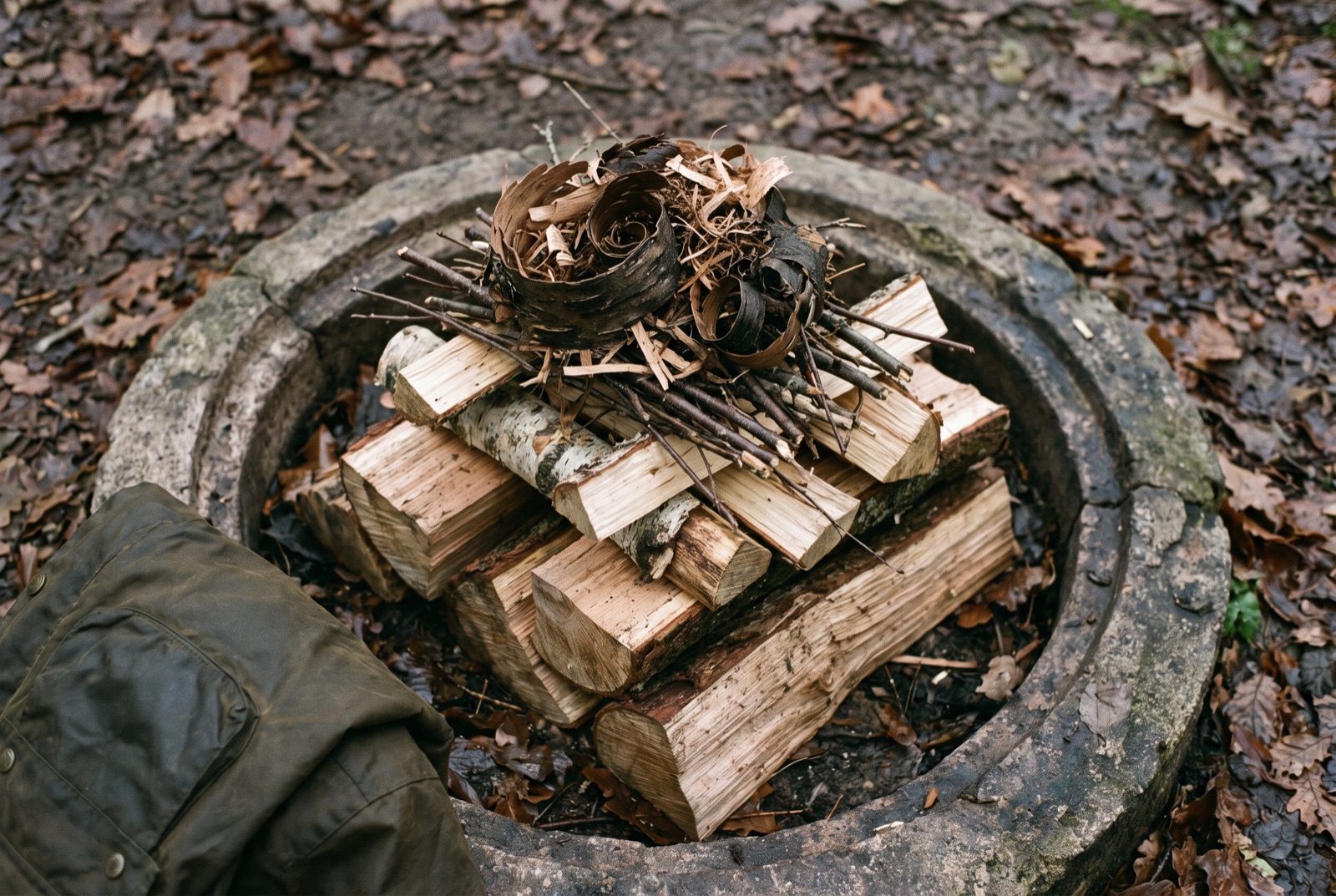
The upside-down lay is counter-intuitive and genuinely better in the wet. Largest pieces at the base, a crossed layer of thinner splits above, then kindling, then the tinder nest on top — and you light the top. The fire burns downwards, radiating heat onto the damp layers beneath and driving the moisture out of each one in the minutes before it is due to catch. It also smokes far less than a bottom-up fire built with damp wood, because the wood is dry by the time it burns.
The rule all three share is air: a tight pile does not burn, it smoulders, and in the wet the instinct to pack everything close to keep the rain off is what kills the fire.
Ignition, and what each method actually fails at
Matches are cheap, honest and useless in wind. Storm matches solve the wind and little else.
Disposable lighters are excellent right up to the point at which they are cold, and then the physics quietly stops. N-butane boils at about −0.5°C; below that the liquid struggles to vaporise and there is no gas at the flint. Vapour pressure roughly halves between 20°C and 0°C, which is why the lighter that worked in the car fails at the pitch. Isobutane blends manage to about −11.7°C. Keep it in a trouser pocket against your leg, and never make it your only ignition source in winter.
A ferro rod works soaked, works cold, works several thousand times, and will not light a single thing you have not prepared properly. Scraped ferrocerium sheds fragments that oxidise in air; the sparks are commonly quoted at around 3,000°C, with some sources going as high as 3,315°C, and it works because cerium ignites at 150–180°C. It fails because something that hot, for that short a time, cannot dry anything for you.
A good fire in the rain is ninety per cent shopping and ten per cent striking.
Gel, wax blocks and commercial firelighters carry no shame; the only argument against them is that they run out and the technique does not. Carry two ignition sources, one a ferro rod, and prepare the tinder before you strike either. None of it works if your matches, your tinder and your hands are soaked — how to pack for rain is the other half of the problem.
Putting it out
Leave No Trace's fifth principle is the short version of the ethics: use an established ring, fire pan or mound fire rather than building a new one, keep it small, use only wood from the ground that you can break by hand, burn everything to ash, put it out with water rather than dirt, and scatter the cool ashes.
The extinguishing sequence is longer than most people's patience. Pour water on the fire. Stir it with a stick or a shovel. Drown it again. Stir it again. Repeat until you can hold the back of your hand near the coals and feel no heat — embers, partially burnt wood and the stones of the ring all cool to the touch, including underneath the stones. Expect several litres, not a mugful, and the hissing must stop entirely before you walk away.
Soil is the trap. Dirt smothers a fire without extinguishing it, and a fire buried in earth can stay live for hours. On wet ground that feels absurd — the fire looks dead and the world is soaking — but heat travels down, and a peat surface can carry it sideways underground long after you have driven home. Smokey Bear and the US National Park Service say so more bluntly than British sources do.
A fire built for cooking is a different fire from one built for warmth — campfire cooking beyond sausages covers what to do with it once the flames have gone. But the forty minutes crouched over a smoking pile were lost before the first match — in the ten minutes you did not spend walking around, looking up.