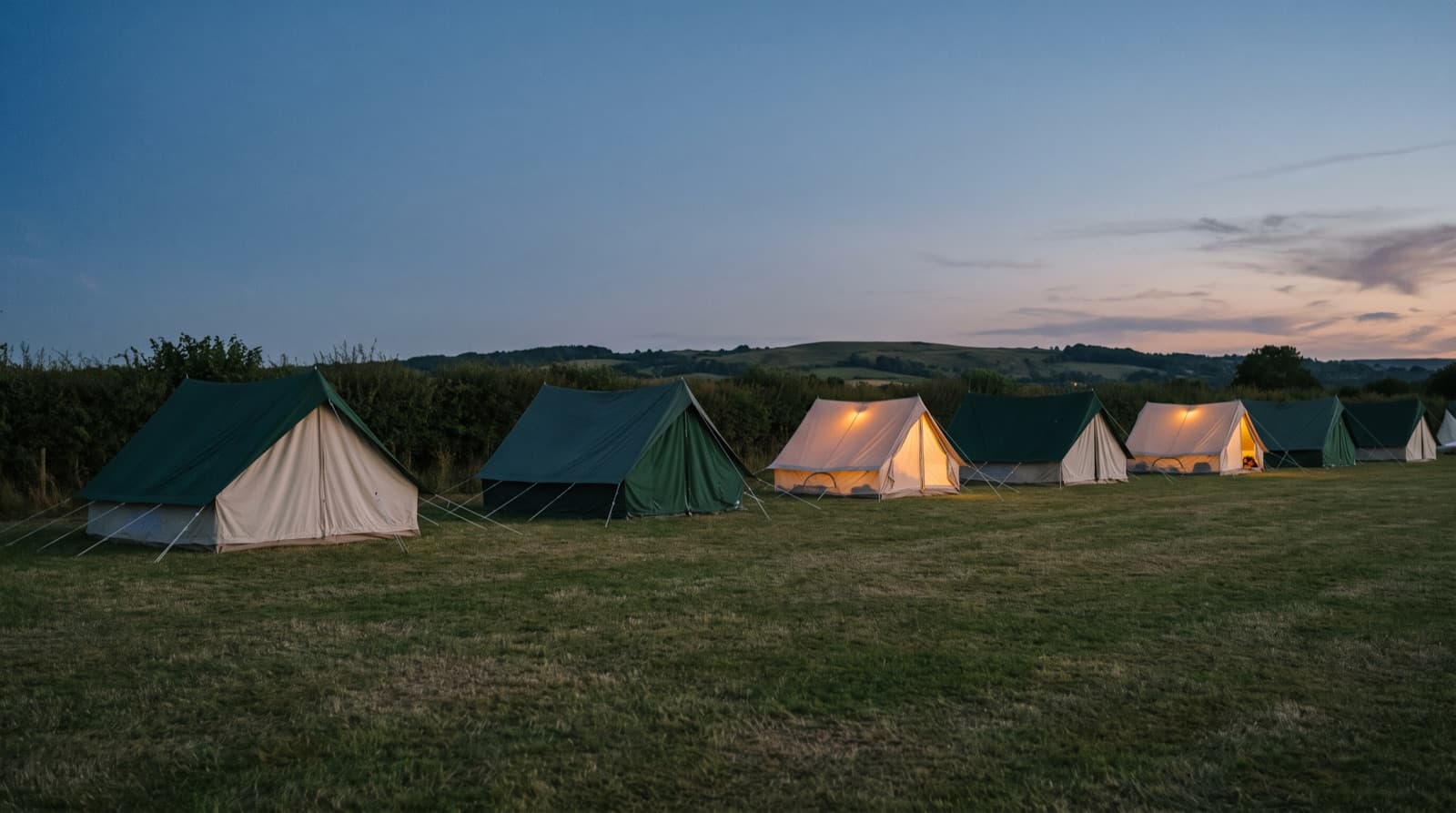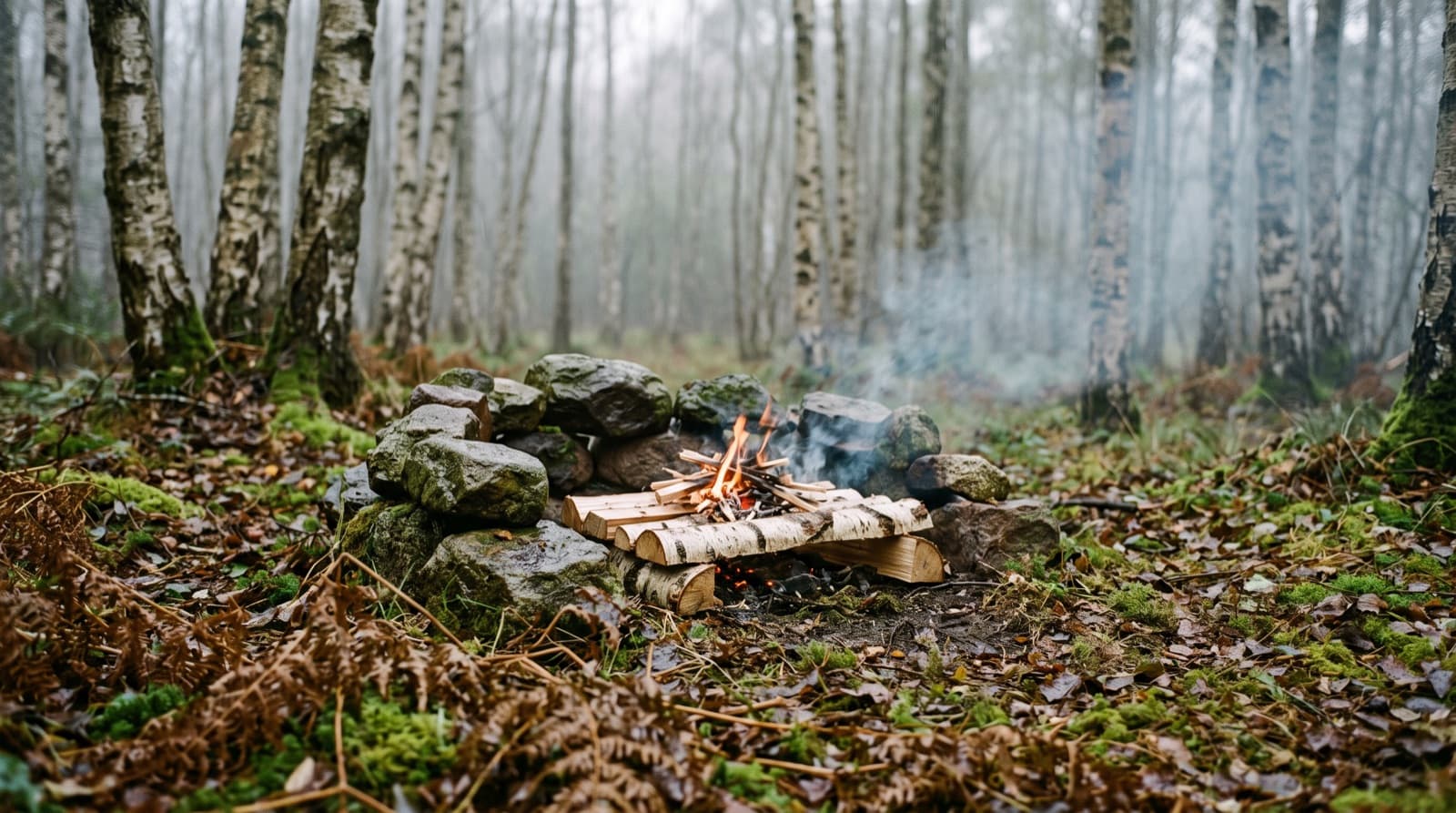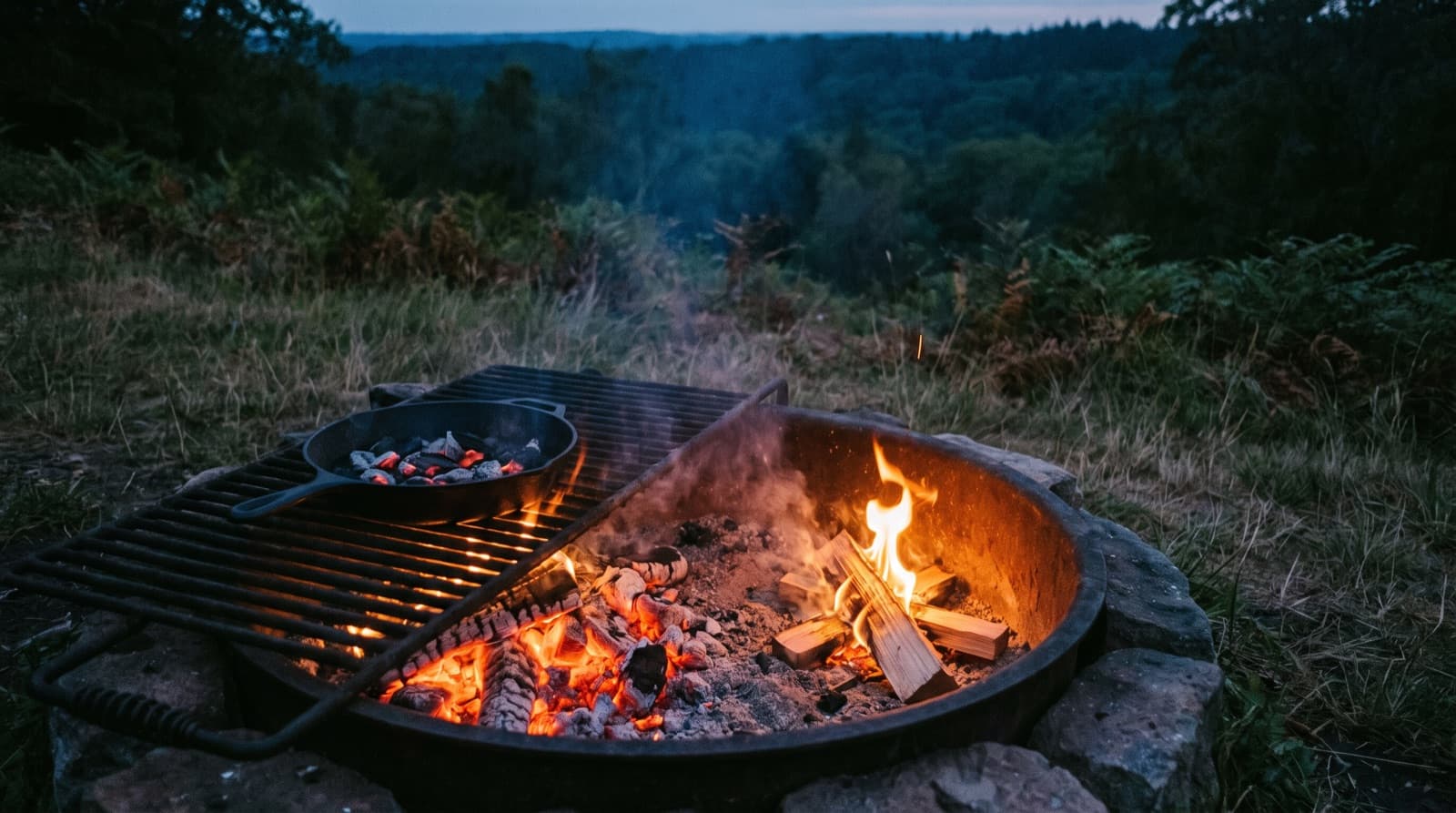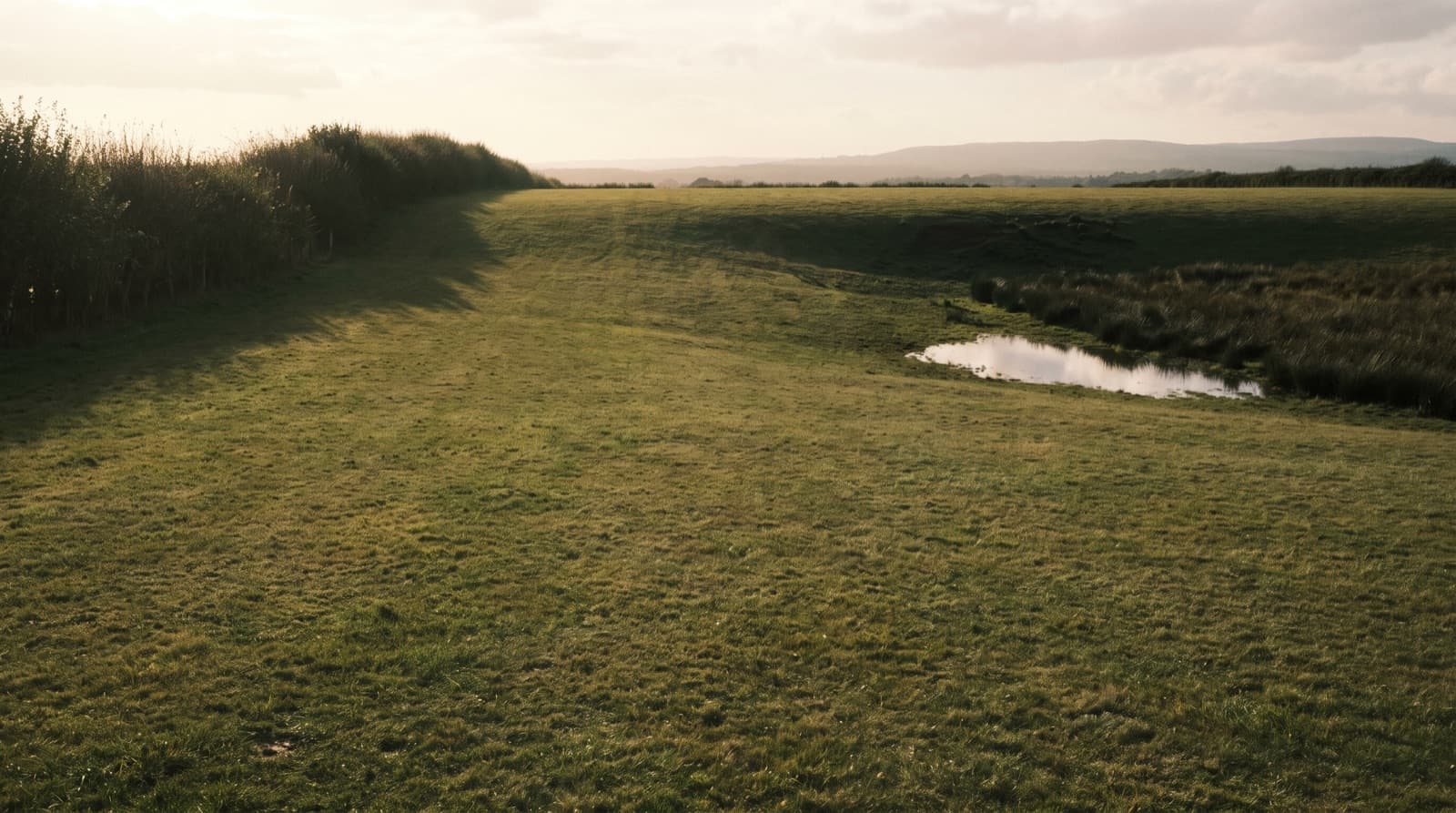
There is a decision to make in the first ten minutes, before anything comes out of the car, and almost nobody makes it deliberately. The field is not uniform. It has a low corner, a wind it has been getting all year, a hedge that shades a third of it until nine, and a history of where the water goes written on the ground in plants. Read that and the pitch chooses itself. Ignore it and you will find out which corner was the low one at about two.
So walk the field once before you unload anything: the ten-minute survey. Four readings — water, slope, wind, and distance to the things that make a noise — and the view is a tie-breaker, even at Three Cliffs. They rarely agree: the sheltered corner is usually the wet one, and the pitch furthest from the toilet block is the quietest and the one you will regret at four. Where the tent then goes up is another discipline. Walk before you say yes to anything: a warden will move you at check-in and not at six. Everything below was checked on 4 August 2026.
Water: read the ground before you read the view
The Camping and Caravanning Club's own pitching advice is blunt: rainwater has to go somewhere, so do not let it go through your tent on the way — "avoid hollows and marshy ground". The Met Office's version is to pitch on high ground.
The plants record where the water has already been. Rushes are the reliable signal: the Farm Advisory Service's note on rush control associates them with poorly drained soils, soft rush the most widespread. Teagasc adds the distinction that makes them usable — rushes mean poor drainage or compaction. A rushy strip along a gateway is a poached track; a rushy patch mid-field is a wet hollow.

Creeping buttercup is the second signal, thriving, the RHS says, in damp soil. The lush green patch is the next reading people reach for, and I can find no authority for it, so take it as mine: grass growth is restricted once the soil moisture deficit passes roughly 50 mm, so in a dry spell the ground still growing is the ground still holding water. In August that is worth a second look; in April it means nothing.
Underneath is texture. US extension tables put infiltration for coarse sand at 19 to 25 mm an hour against 2.5 to 7.6 for clay loam — generic textures, not British ones, but the ratio is the point, and a poorly drained field holds water for days rather than hours. Reading the ground is the half you solve before unpacking; the other half is how to pack for rain.
Slope, and which way round you sleep
There is no statutory maximum gradient for a camping pitch in Britain. Both sets of Model Standards made under section 5 of the Caravan Sites and Control of Development Act 1960 — the touring standards of 1983 and the holiday standards of 1989 — specify no maximum gradient and no levelness requirement at all. What they contemplate is ground that may become "difficult or dangerous to negotiate in wet weather": they assume the field is uneven and wet, and legislate around that rather than for it.
The practical rule is the club's: flat if you can get it, and if not, head uphill and the doors facing downhill. That is not folklore. A systematic review of head-of-bed elevation for reflux found, in its highest-quality trial, participants 2.1 times more likely to report clinically meaningful symptom improvement (RR 2.1, 95% CI 1.2 to 3.6); one trial used a 10 per cent slope. The authors' own caveat: "methodological and reporting limitations in available literature preclude confident conclusions."
The cross-slope is the one nobody mentions, and it is worse than a fall: everybody migrates to the low wall within an hour and stays there. If you cannot get flat, run the fall head to foot rather than across. What the slope buys is the drier ground.
Wind: what shelters, and what only looks like it
Prevailing west to south-westerly winds, the Met Office notes, leave northern and western areas more exposed than the south and east; the windiest places by mean wind speed are Shetland at 14.6 knots, Orkney at 14.3 and the Western Isles at 12.6. The field keeps its own record: the lean of a hawthorn, the side of the wall where the grass grows longest, the pitches still empty on a full site.

A permeable barrier shelters further than a solid one. Purdue's extension work puts fences with 25 to 50 per cent open space ahead of solid ones, a porous barrier protecting for about 20 times its height and a solid one only five to fifteen. Utah State supplies the mechanism: wind deflected up over a windbreak is drawn straight back down by the low pressure behind it. Both are US sources; the aerodynamics travel. Call a hedge worth ten to twenty times its height — five metres of hedge is worth walking fifty metres to get behind, a two-metre wall almost nothing at thirty. Which way the tent then points, and what holds it down, is packing for wind.
Trees, and the hazard that happens on still days
Almost every camping article treats a tree as a windy-night hazard. The documented British failure is the opposite. Summer branch drop, described in a 1989 arboriculture research note reviewed in 2007, has been reported on oak, sweet chestnut, beech, ash, poplar, willow and horse chestnut. The limbs are at least 10 cm in diameter and usually extend to or beyond the edge of the crown. The note is explicit about conditions: it is believed to be associated with "calm weather conditions following a heavy rain shower" ending a period of increasing soil dryness. A warm, still July afternoon after a downpour — exactly when the tree looks most inviting.
The tree that drops a limb on a British campsite does it on a still, warm afternoon after rain — not in the gale you were worried about.
The honest arithmetic belongs next to it. National Tree Safety Group guidance published with the Forestry Commission puts the average individual fatality risk from a falling tree to the UK public at less than one in 10 million a year over 1999–2008, and one in 15 million over 1997–2021 — against the HSE benchmark that one in a million a year is a very low level of risk. Trees are not dangerous. The risk sits in identifiable trees you can walk away from in thirty seconds.

Ash is the second and newer reason: Forest Research has ash dieback causing basal lesions that weaken the trunk and make the tree more prone to falling, in scenarios projecting more than 95 per cent loss of ash over 50 to 100 years. Ash is on the summer branch drop list too.
The everyday reason is duller. Forest Research puts canopy interception at 25 to 45 per cent for conifers and 10 to 25 per cent for broadleaves, to a maximum of 5 to 7 mm in a day — water that comes off in fat, slow drops for hours, so a pitch under a tree stays wet longer than the weather was. Both authorities say it plainly: the club calls pitching under a tree a big no, the Met Office says not to shelter beneath one. Take the shelter of the hedge or the wall, and the tree's shade only beyond its longest limb.
Sun, and which end of the day you are buying
At the June solstice in London the sun rises at 03:43 at a true azimuth of 48.9 degrees, about 41 degrees north of due east. At the March equinox it rises at 89.1 degrees, effectively due east. On 21 December it does not rise until 08:04. So an east-facing pitch is in full sun before four in the morning in June, and not lit until after eight in December.
Which inverts what you want: morning shade in high summer, morning sun in spring and autumn, when it is what dries the flysheet and burns off the condensation before you pack. Choose for the morning either way — you are awake in the evening and can move a chair, and asleep at half past four in June. At four in the afternoon you can see where the hedge shadow will fall at nine tomorrow, on the opposite side.
Distance: taps, blocks, bins, roads and the play area
The statutory geography explains the layout. On a touring site, no pitch should be further than 90 metres from a water tap, a waste water disposal point or a fire point. On a holiday site, no caravan standing should be more than 50 metres from a road.
None of the trade-offs resolve. The toilet block is a night-time convenience and a morning-and-evening noise source. The bins are the shortest walk you make most often and the thing you want furthest away in warm weather. The play area is the best thing on the site until half past seven. The site road is the flattest, driest ground and carries every arrival.
All four are predictable from the car park. The unpredictable one is the people either side of you, which is somebody else's subject, along with the eleven o'clock rule. One number makes the road concrete: the WHO's 2018 environmental noise guidelines strongly recommend night noise below 45 dB for road traffic — well under an ordinary conversation, and nowhere near what a site road delivers on a bank holiday Friday.
When you cannot choose at all
For a booked cabin, pod or glamping unit somebody else chose the siting, and British practice is mixed. Camping in the New Forest states its sites are without allocated pitches and guests choose where they set up — with a named exception, that electric pitches at Holmsley are allocated on arrival. The Caravan and Motorhome Club sits in the middle: specific pitches cannot be reserved with a booking, but on arrival guests may choose any available pitch of the type booked, unless the outfit, safety or ground conditions require otherwise. Some parks allocate outright, and Pettycur Bay says so with a flat no.
So the survey becomes questions, asked before you book. Which way does it face at breakfast. What is above it. Where does the water come off the roof and the deck. How far is the car. What is the nearest thing that makes a noise, and when. An owner who answers those precisely tells you a great deal about the place. Booking systems abstract pitches into categories; the only way to discuss a specific one is with the owner, which is one of the better arguments for booking direct.
The ten-minute survey is not about finding the best pitch, because there usually is not one. It is about knowing, before anything comes out of the car, which of this field's four problems you have chosen to have.