The Met Office's camping advice does not lead with rain. It leads with wind, and with a number most campers would find implausibly low: speeds over 30mph can damage a tent. That is a strong breeze — large branches swaying, wires whistling — nowhere near a storm. Rain ruins an evening. Wind is the only weather here that breaks the thing you were going to sleep in, and the only one where the right answer is sometimes to drive home.
The failure mode
Rain and cold leave you the same way out: you go to bed. Wind offers nothing of the kind, because the thing tested is not you. It is the tent, and it fails structurally and fast — a pole through the flysheet, a groundsheet coming up as a bag, an awning across three pitches at two in the morning. None of it recoverable by lying down and waiting for daylight.
The method is the one used throughout this series: name the failure mode, then pack backwards from the night. Each article has a line that must not be crossed. In rain it is the wet/dry line; in cold the vapour line; in heat the shade line. In wind it is the abandon line — the wind speed, settled in daylight and said out loud, at which you stop improving the pitch and start taking it down. Nobody reaches that number honestly at two in the morning.
The published thresholds are lower than anyone assumes. The Met Office says speeds over 30mph can cause damage; the Camping and Caravanning Club puts most tents at 25 to 30mph, or 40 to 48 km/h, and calls anything stronger a serious risk. Neither is a storm. Such numbers matter because wind does not load a structure in proportion to its speed. Dynamic pressure rises with the square of velocity, so doubling the wind quadruples the force, and 30mph to 40mph — a difference nobody would remark on — is a 78 per cent increase in load.
What the forecast is actually telling you
A forecast gives two numbers and most people read the wrong one. The mean is an average; the gust is the peak, and tents are destroyed by peaks. A forecast of 25mph gusting 45 is a 45mph forecast.
The Beaufort scale is the better instrument in a field, where there is no forecast for the hedge you are standing behind. Force 6, a strong breeze, is a mean of 24 knots, about 28mph, where large branches sway. Force 7, a near gale, is 30 knots, about 35mph — twigs break off trees and walking against the wind becomes difficult. Force 8, a gale, is 37 knots, about 43mph. Force 7 is the one to learn: legible from inside the tent, common in Britain, and where tents begin to fail.
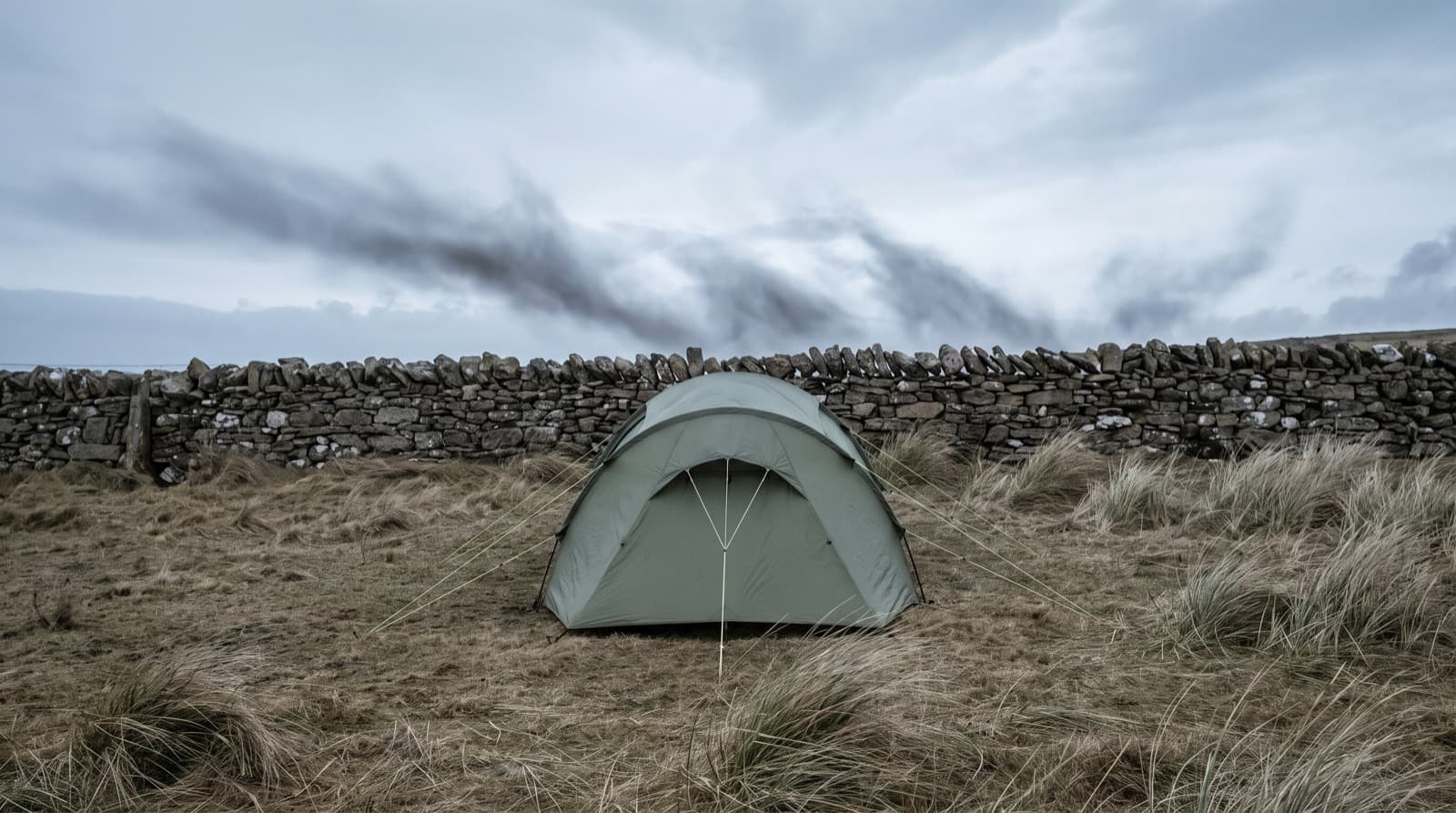
Where you are matters more than the number: a regional forecast averages a landscape, and a valley mouth, a ridge or a coastal field will each see something it never mentioned. The site is the last instrument — which way the hawthorn leans, which side of the wall the grass is long on, which pitches are empty in an otherwise full field. All of it part of the ten-minute survey you run on arrival.
Orientation: the narrow end, and where the door goes
One line from the Camping and Caravanning Club carries most of this: face the narrow end of the tent in the direction of the wind, so that it cuts through gusts rather than taking the full force on its side. For a tunnel tent that is not a preference but the design, one of several properties the number on the box does not tell you. The Club is equally plain about the part people get wrong: position the doors away from the wind. A door facing into wind turns the tent into a pressurised bag, and internal pressure is how poles snap and pegs pull.
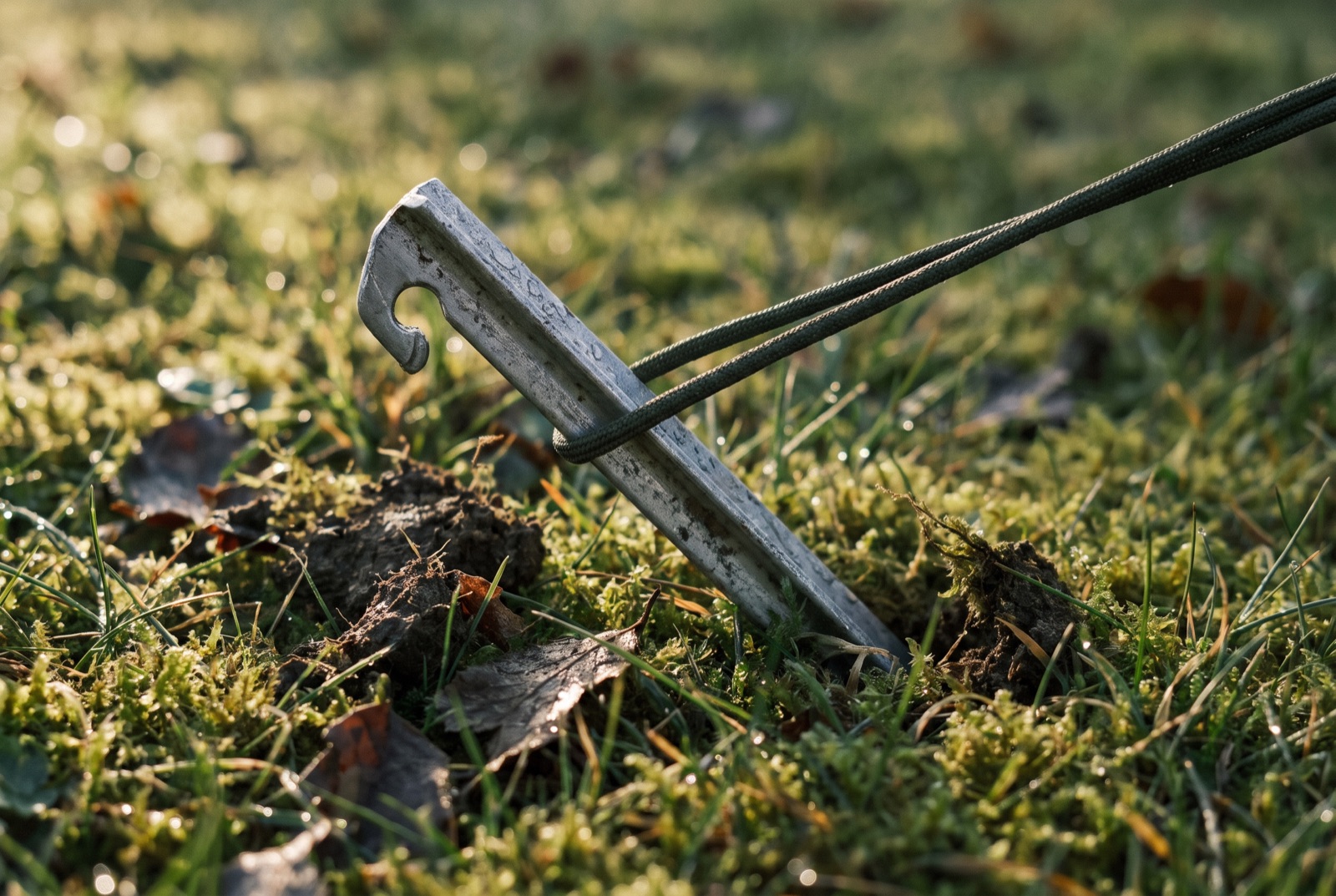
That is all true of a finished tent, which is the point of the Met Office's most under-quoted line: remember the tent has no aerodynamic qualities until it is fully pitched. The danger is the interval in which it is half up. Peg the windward corners first, weight the fabric, thread poles from the downwind end, and put nothing down that could leave.
Shelter is worth having for its own sake. Still air at 2 °C is pleasant and the same air at 30mph is not, so a sheltered pitch is worth several degrees before you put a layer on — where this hands over to packing for cold. Wind arriving sideways is still a containment problem, and containment belongs to packing for rain.
Anchoring: pegs, guys, and the part everyone leaves in the bag
The pegs that came with your tent are the cheapest component in the bag, chosen to pack flat rather than to hold a flysheet in a near gale. Replacing them costs less than a night's pitch fee, and almost nobody does it.
Match the peg to the ground and carry a mix rather than a set. Firm turf takes wire shepherd's hooks, easy to extract but inclined to bend and spin. The British default is the Y-beam, the best surface-area-to-weight ratio for most ground here. Rocky ground wants something thin enough to find a way between buried stones: nails, pins or needle stakes, titanium from around 8g. Sand wants wide, concave blizzard stakes, buriable sideways as a deadman. Baked August ground defeats a standard peg entirely — the peg question packing for heat sends over here — as does turf over bedrock, where purpose-made ground anchors at about 49g are the only honest answer.
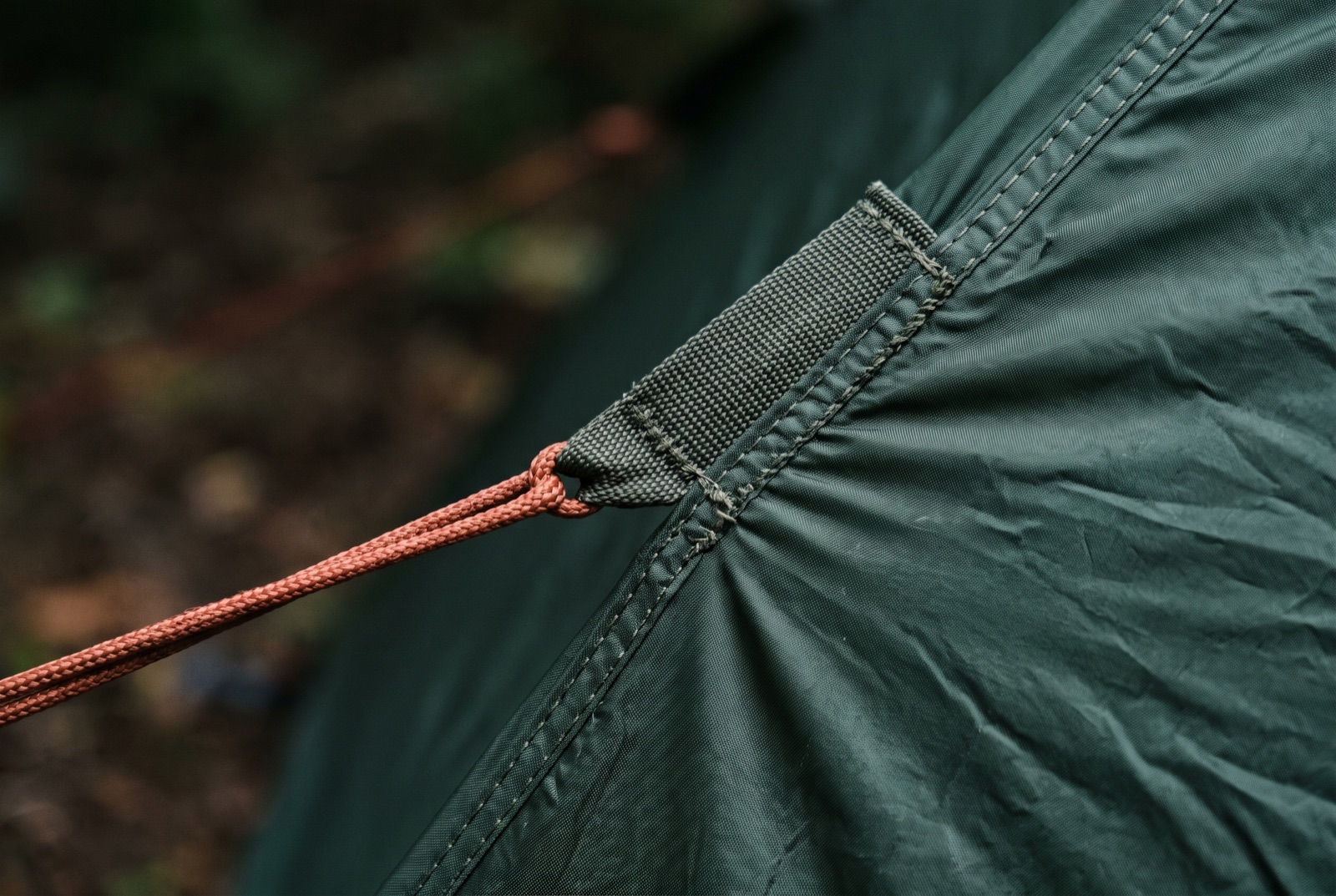
The angle is the same number twice, which is why it is worth learning once. Drive pegs at around 45 degrees away from the direction of pull, whole peg in: one left proud is a lever, and the wind holds the long end. Run guy lines at roughly 45 degrees to the ground, continuing the line of the pole they support so load runs down it rather than bending it. Flatter holds better at the peg; steeper supports the pole.
Use every guy point, every time, and tension the bands inside the tent that hardly anyone unclips: Vango's TBS II and its equivalents brace the pole at three points and reduce sideways movement. Then retension through the evening. Fabric stretches wet and slackens dry, and the Met Office is explicit that ground softens during and after rain, so pegs that held at six are loose at midnight.
Wind loading rises with the square of the speed. The gust that takes your tent is rarely the one in the forecast — it is the ten miles an hour nobody noticed arriving.
Cooking in wind, and the reason not to shelter the stove
Wind wrecks a stove: it strips heat off the pan, blows burners out and throws flame sideways, so the instinct is to move it somewhere sheltered. That instinct is the most dangerous idea here.
The rule takes no hedging. No stove, no barbecue and no fuel-burning appliance goes inside a tent, an awning, a porch or a vestibule — including one switched off, because barbecues give off carbon monoxide for hours after use, even when no longer smoking. Hannah Thomas-Jones, 14, died in 2013 after a used barbecue was left in the porch of a family tent in Shropshire; three others were found unconscious.
Around 200 people a year are hospitalised in the UK with carbon monoxide poisoning, around 40 of those cases fatally, and the Gas Safe Register reports one in five people here do not know the danger of a barbecue in a tent. The symptoms are ordinary enough to pass for a bad night: headache, dizziness, feeling or being sick, weakness, tiredness and confusion, chest and muscle pain, shortness of breath. Anyone struggling to breathe, suddenly confused, unconscious or weak is a 999 call.
One correction, because several camping sources get this wrong and the error is a comforting one. Carbon monoxide does not sink and hug the ground: its molecular mass is 28, marginally below air at about 29, and it mixes readily. A porch kills because it is enclosed, not because gas pools in it — worse rather than better, since there is no low corner to avoid.
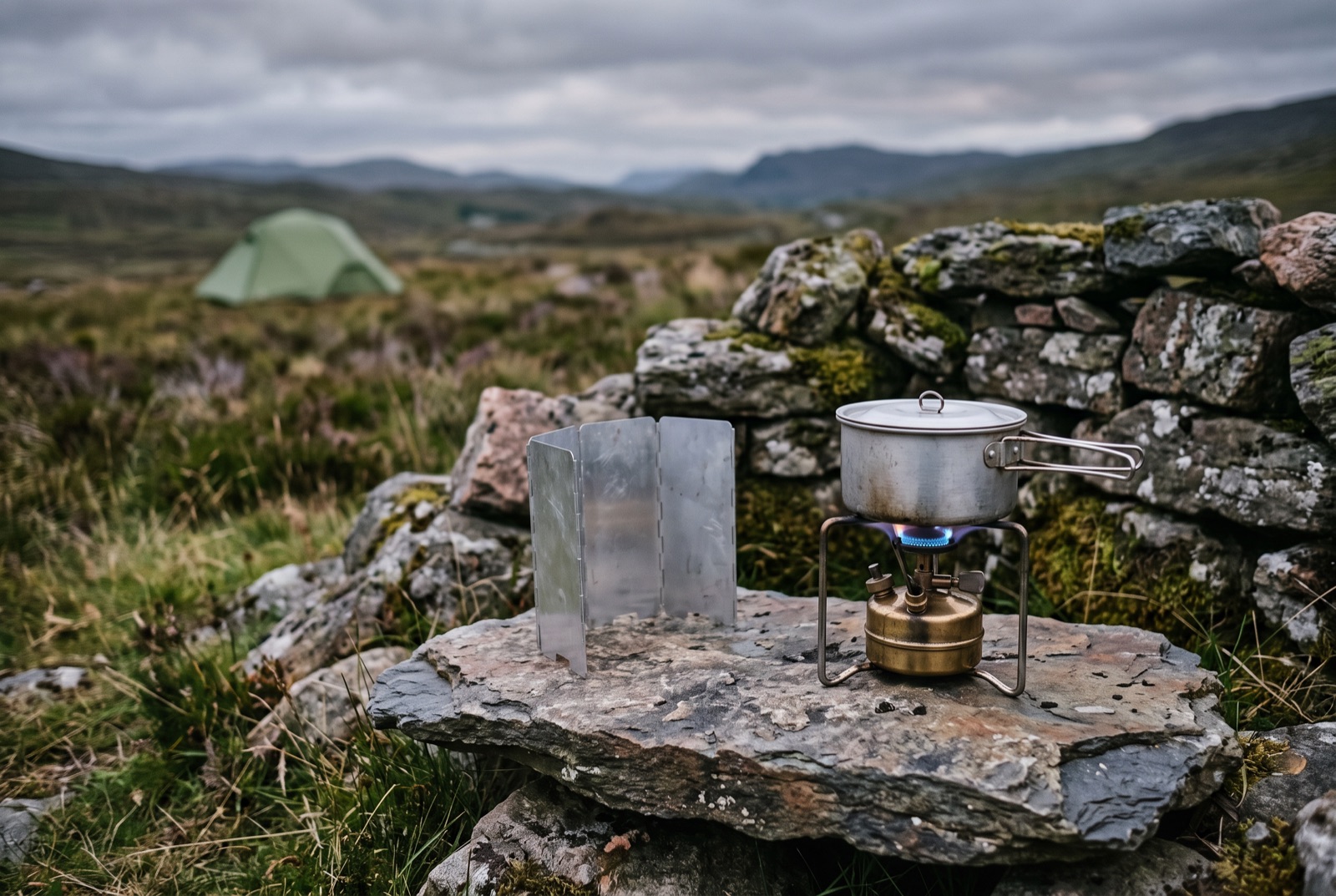
Cook outside instead, in the lee of something solid that is not your tent — a wall, a hedge, the car — with a windshield and the stove's clearances respected. Then the BMC's two rules: never use a liquid or solid fuel stove in an enclosed space, and never block your only exit with the stove. Liquid and solid fuels produce carbon monoxide far more readily than gas.
Everything that is not the tent
Awnings and porch extensions come down first: they are the largest sail on the pitch and the commonest source of damage to other people's property. The Club's instruction is to remove them before high winds arrive, and caravanning guidance commonly cites around 20mph, since taking an awning down in a gale is itself hazardous. The decision is made early or it is made badly. Windbreaks are the same hazard in miniature: a well-pegged one helps, a badly pegged one is a sail on steel poles pointed at your neighbours.
Loose kit goes in the car or the tent before dark, not when it starts moving: chairs, tables, stoves, hammocks or decorative items, and by extension gazebos, drying lines and anything inflatable.
Then trees, the one shelter worth refusing. The Met Office asks campers to be especially mindful of overhanging or rotten branches which could fall in high winds, and the hazard has a name: the widowmaker, a dead limb already broken free and lodged in the canopy. It can sit for years and come down on one gust. Shelter from a hedge or a wall is worth having; from a mature tree it is not.
When to strike, and when to leave
Striking in wind is a two-person job done in a deliberate order. Everything comes out of the tent first, so nothing is being rescued while the fabric is loose. Leeward guys come off last, and you never unpeg the windward side while the fly is up. A tent that gets away in a gale is gone, and it can injure somebody downwind.
Then the abandon line, made concrete: the Club's own position is that if the wind becomes too strong you leave the campsite entirely. No version of this exists in which the tent is worth more than the decision, and most sites will not charge for the unused night if you tell them why.
Read the forecast properly and all of this stays cheap: the gust figure and the warning colour rather than the summary line, the evening before as well as the morning of. Met Office warnings run on impact and likelihood rather than wind speed alone, but amber wind warnings routinely carry gusts of 60 to 80mph and warn of risk to life and property.
The highest gust recorded at a low-level site in the UK is 123 knots — 142mph, at Fraserburgh on 13 February 1989. You will never camp in that. You will camp in forty-five, more often than you would guess, and the difference between the people who cope and the people who lose a tent is what was decided in daylight.