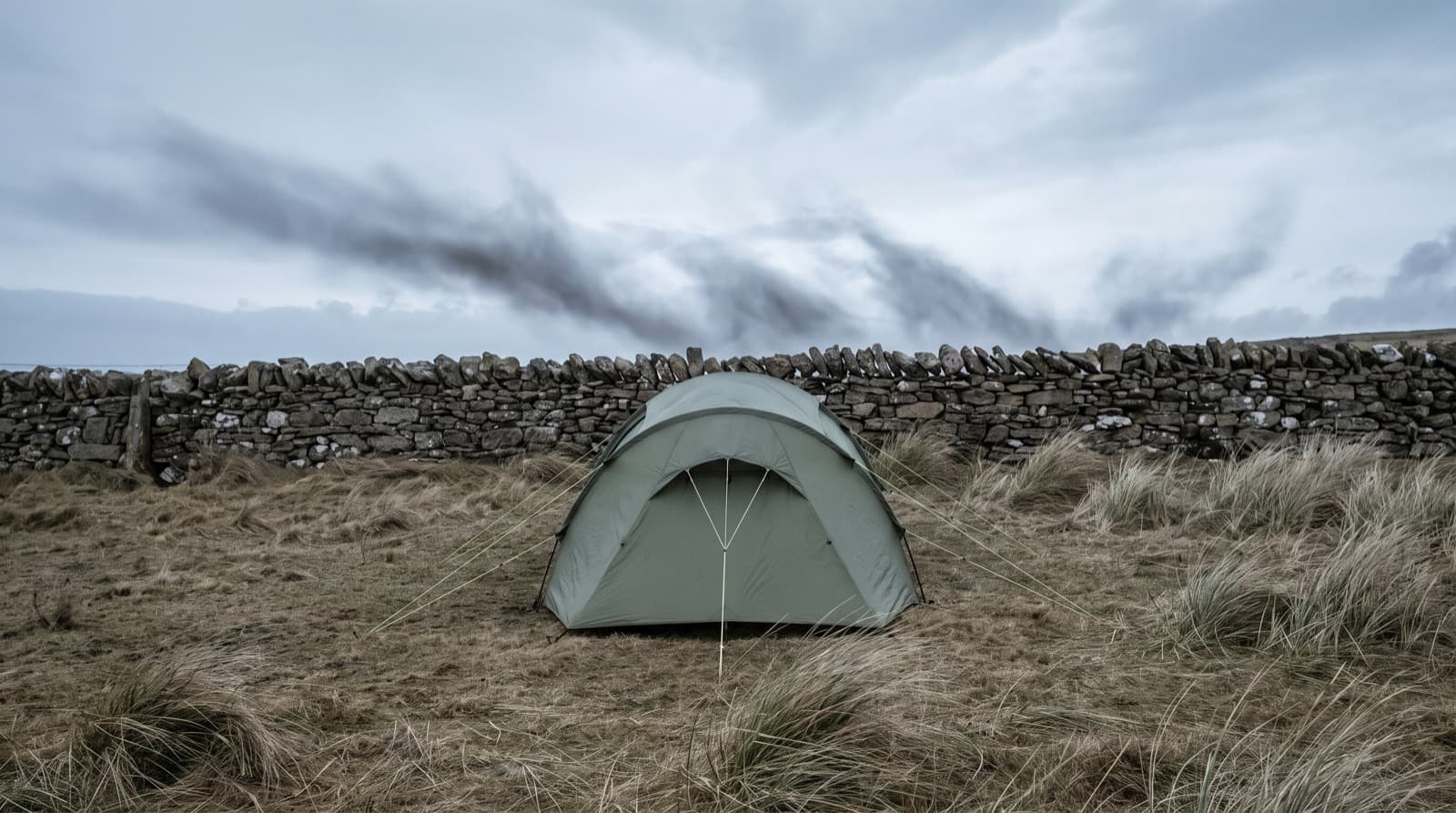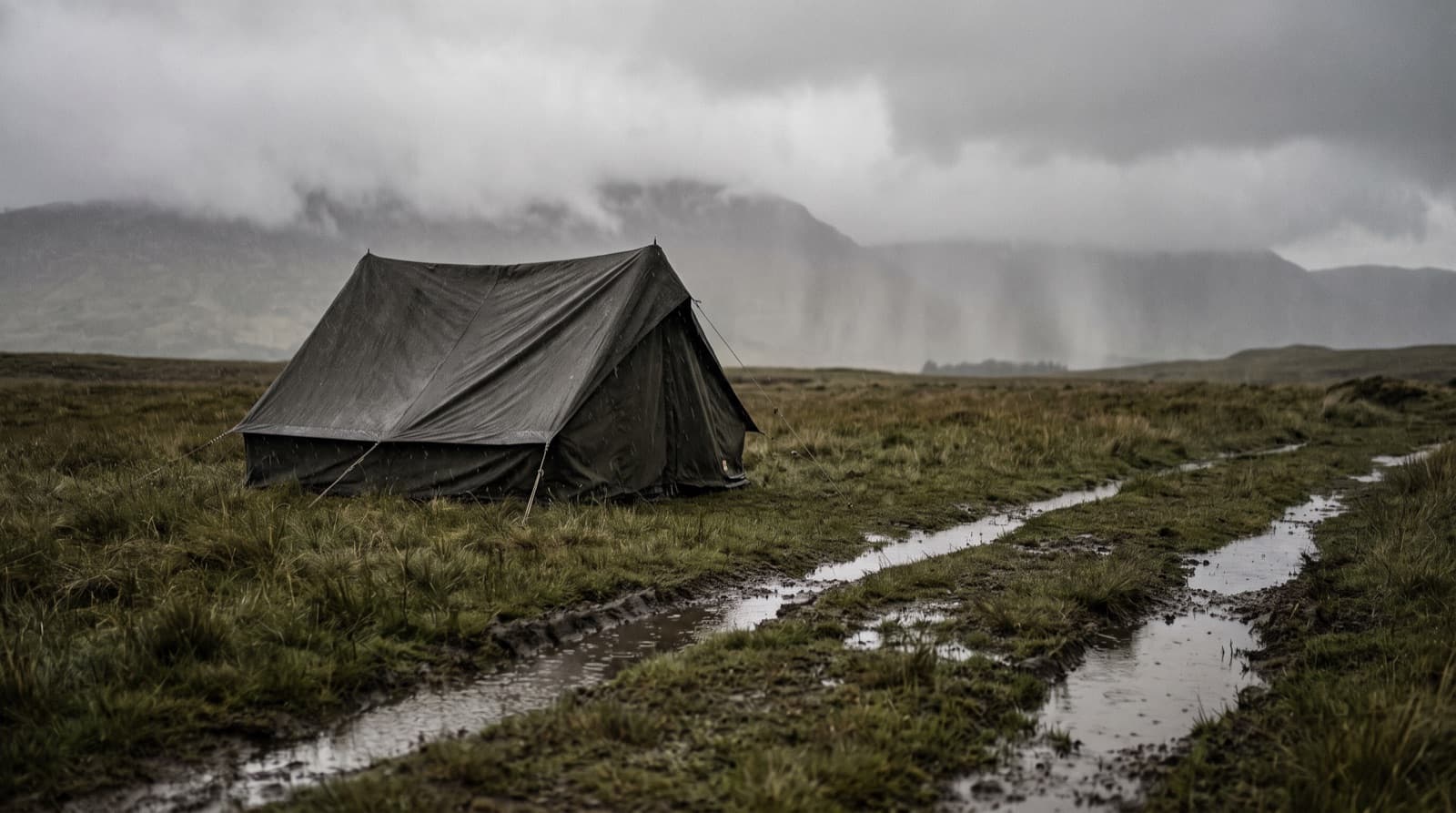
Nobody's trip is ruined by rain falling on them. It is ruined by rain that has got into the thing they intended to sleep in. That distinction is the whole of this article, and it is why a packing list made of jackets — however good the jackets — solves the smaller half of the problem. A tent in the rain has one dry room. Everything else is a decision about who is allowed into it.
The failure mode
Name the thing that would actually end the trip, then pack backwards from it. Getting wet does not end trips. People get wet, they get changed, they get on with it. What ends a trip is a wet sleeping bag, a wet spare base layer or a wet down jacket, because none of those can be recovered in a field. There is no drying a down bag on a British campsite in October. Once it has gone, it has gone for the duration.
That is the failure mode. Everything else follows from it.
British rain is not dramatic. It is relentless. The UK averages 159 days a year with at least 1mm of precipitation, and around 1,163mm in total, on the 1991–2020 averages. That is a background condition of the country rather than a crisis, and it wants a system rather than an emergency response. The system is two sets of clothes and a line between them that is never crossed for convenience — not at the end of a long day, not for a minute, not when you are tired.
Two wardrobes, and the line between them
Walking clothes and sleeping clothes are different objects governed by different rules. Walking clothes are expected to get wet and are chosen accordingly. Sleeping clothes have never been outside, will never be outside, and exist for the eight hours between getting into the tent and getting out of it. They live in their own bag and they come out at one moment in the day.
This is where cotton loses the argument, and it is worth having the physics rather than the slogan. Water conducts heat away from the body roughly twenty-five times faster than air does. Cotton is hydrophilic: it takes on many times its own weight in water, holds that water against the skin, and will not wring out. A cotton t-shirt under a shell is a reservoir with you inside it.
The clinching evidence arrived in 2024, in a randomised crossover field study published in BMC Emergency Medicine. Eight volunteers were cooled for thirty minutes in wet cotton in a snow cave at 3.1 °C, then re-warmed two ways. With the wet clothing removed, skin temperature returned to baseline in a mean of 12.5 minutes; with the wet clothing kept on — wrapped in insulation and a vapour barrier, which is the best case anyone manages in the field — it took 28.1 minutes. Wet layers are not nearly as good as dry ones. They are more than twice as slow, with the odds stacked in their favour. Take the same principle far enough and it stops being about comfort: hypothermia is a core temperature below 35 °C and a medical emergency, and wet clothing is the fastest ordinary route to it.
So the rule is short. You do not get into the sleeping bag in anything you walked in. Not the socks. Not the base layer. Not just for a minute.
Containment: dry bags, bin bags, and what actually seals
The Met Office's own camping advice is unusually blunt on this: pack your clothing and bedding in plastic bags before packing them into rucksacks. A rucksack is not waterproof. A rain cover is a windproof shroud with a hole in the bottom, not a seal. Anything that must arrive dry has to be individually wrapped before it goes anywhere near the outside.
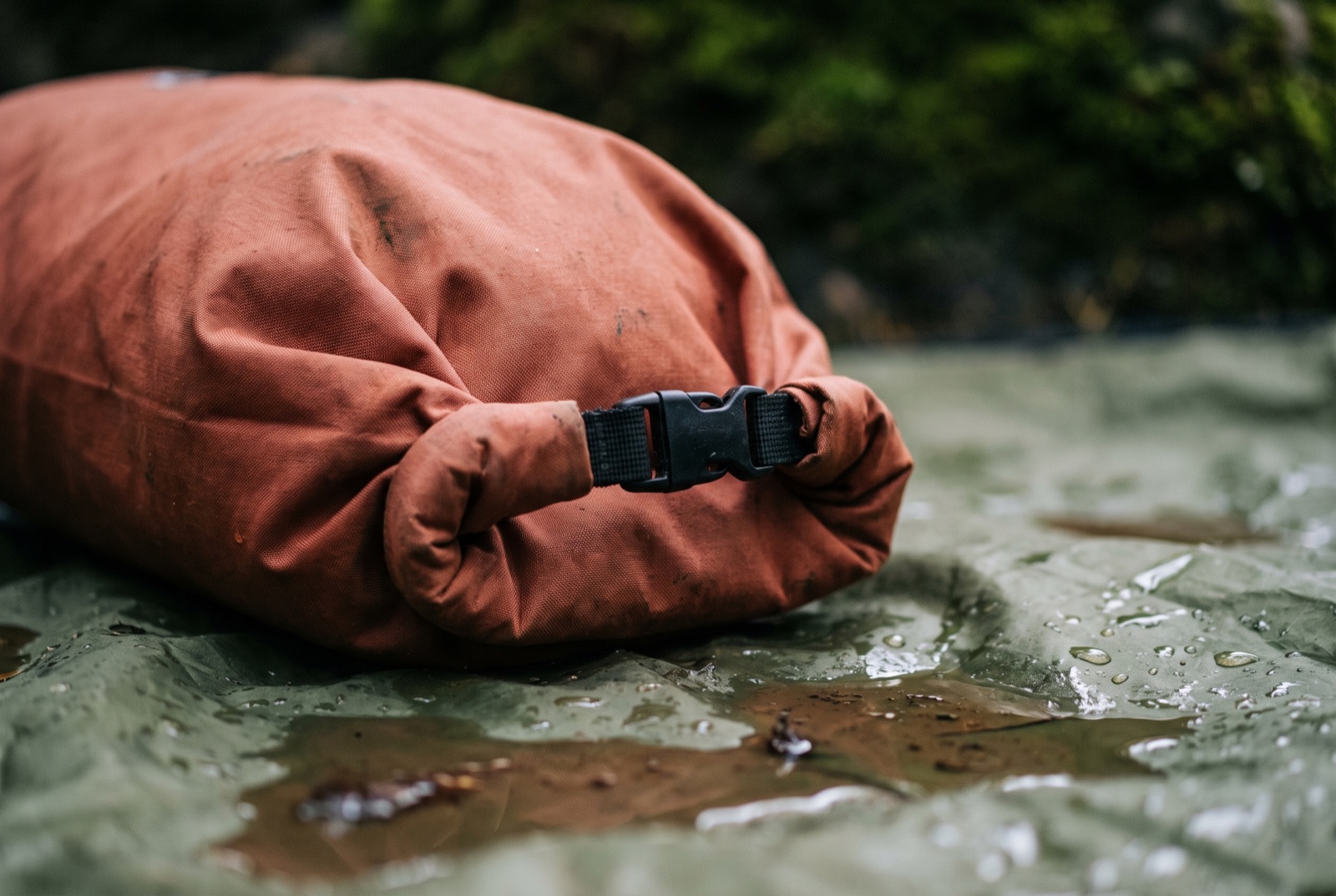
The most common failure with a roll-top dry bag is not the bag. It is the closure. A roll-top wants at least three folds before you clip it; with two, water has been observed seeping in within two minutes. Sea to Summit's own instructions specify three to four rolls, which is worth knowing because almost nobody does it. Two folds looks closed. It is not.
Bin bags genuinely beat dry bags in some places: bulk, cost, the whole sleeping bag going into one liner inside its stuff sack, everything in the boot of the car. They lose wherever something is opened and reclosed repeatedly, or dragged over anything abrasive. Colour-code by function so the dry set is identifiable in the dark without opening it. In a tent at eleven at night with a head torch, you want to reach for a colour rather than conduct an inventory.
What the label promises, and what it delivers
Hydrostatic head is the number on the swing tag and it is measured under ISO 811 (BS EN 20811): a column of water in millimetres that the fabric holds before it lets water through. In the UK a fabric may be marketed as waterproof at 1,500mm. Under EN 343, 800mm is Class 2 and 1,300mm is Class 3. For a flysheet, 1,500mm is a floor rather than a target — it is where the law lets a manufacturer use the word, not where the tent stops leaking, and the numbers on the label reward a closer read than they usually get.
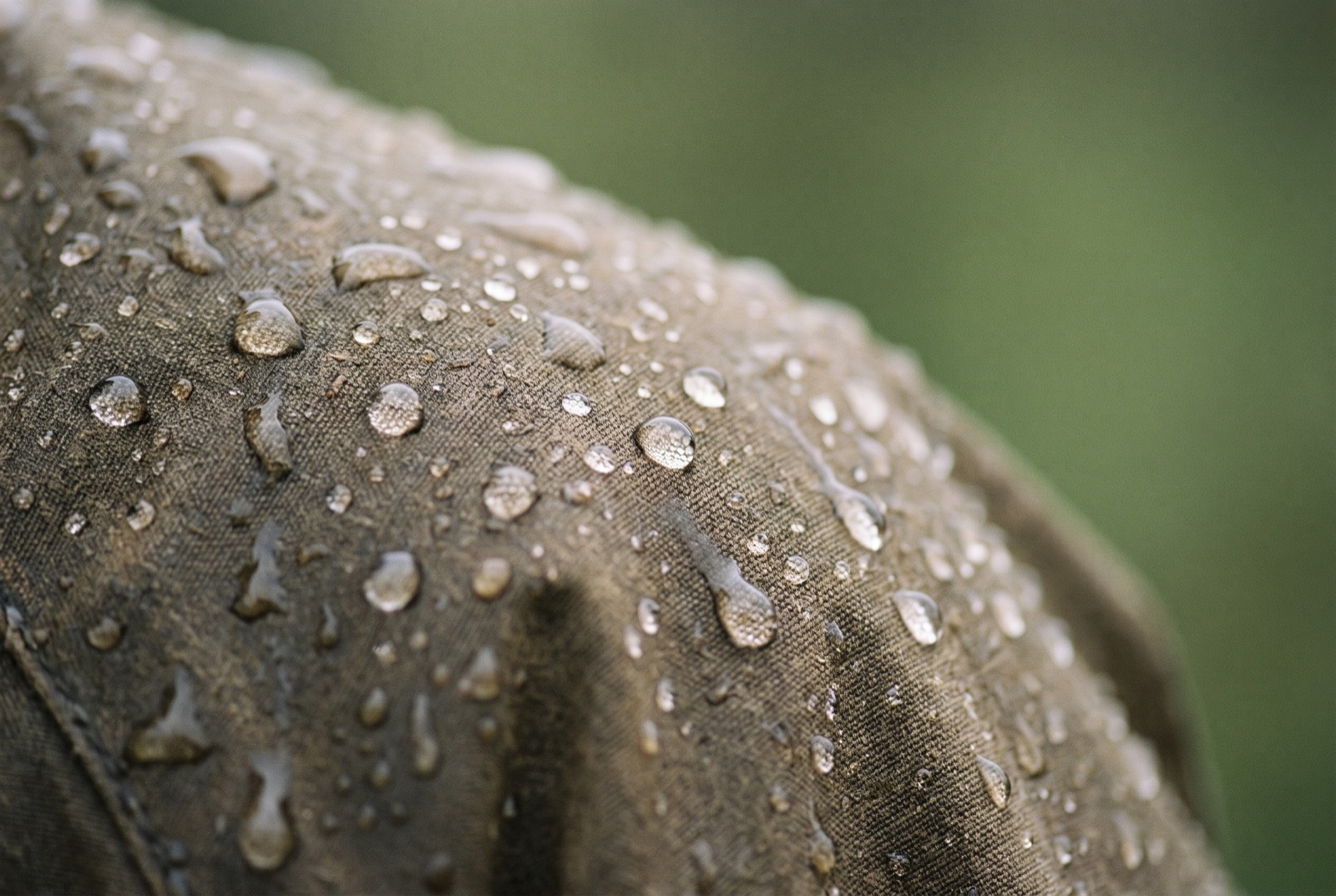
The other thing labels do not tell you is that jackets mostly fail from the outside in. When the durable water repellent finish stops working, the face fabric saturates — wetting out — and a saturated face fabric will not pass vapour, so the membrane behind it stops breathing and you get wet from your own sweat. The jacket has not failed. The finish has. Reproof roughly every fifteen to twenty uses, or whenever water stops beading and starts soaking in.
Insulation follows the same logic. Wet down loses eighty to ninety per cent of its loft, and hydrophobic treatments delay that rather than prevent it. In a damp climate over several nights, synthetic is the honest choice. The full sleeping-system argument — ratings, mats, what actually keeps you warm — belongs to packing for cold, which is the second half of this problem arriving a few hours later.
Pitching and striking in the rain
The Met Office's first instruction, before any technique, is to wait for conditions to improve. Most people pitching in rain are in a hurry for no reason at all; twenty minutes in the car is frequently the whole solution. If you cannot wait, the advice is to set up a tarpaulin over the pitch and work beneath it, which sounds fussy until the first time you do it. Inner-first tents are at a real disadvantage here, because the bedroom is exposed while you fight the fly. If you buy tents with British weather in mind, fly-first or all-in-one pitching is worth more than most of the features that get advertised.
Where you pitch matters more than how fast. Elevated and well-drained beats sheltered and pretty, which is the first thing the ten-minute survey is for. Then the groundsheet: the lip stays inside the tent. A groundsheet edge sticking out from under the fly is a gutter aimed at your bed.
Striking wet is a skill of its own. Shake the water off, wipe the fabric down with a clean dry cloth — never one that has been washed in detergent, because detergent residue lets water penetrate the coating — and then put the tent loose over the luggage in the boot rather than back in its bag. A stuff sack is a sealed damp container, and the drive home is three unsupervised hours in it.
Rain does not end trips. Rain that has reached the sleeping bag ends trips, and there is nothing you can do about it in a field.
Living in it: the porch, the walls, the vents
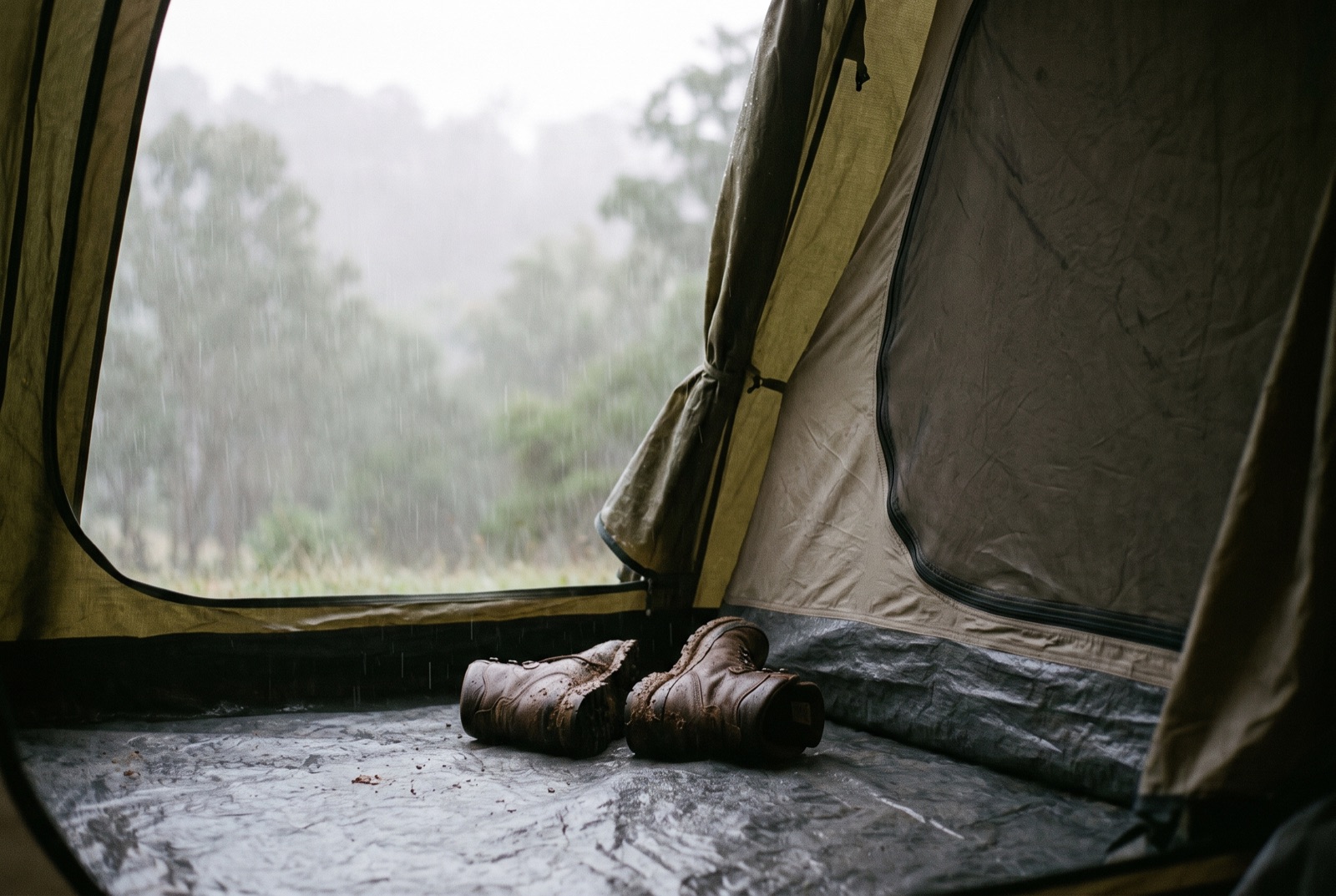
Run the porch as an airlock, because that is what it is. Boots and waterproofs live there, on their sides, and they do not come further in. Nothing touches the inner walls: a rucksack leaning against the fabric wicks water through a membrane that would otherwise have held, which is the origin of a great many leaks that were never leaks.
Open the vents the moment the rain eases. Condensation is far more common than a genuine failure of the fabric, and at three in the morning the two are indistinguishable — a fine wet mist on the inside of the fly, and a conviction that the tent is finished. It usually is not. The physics of this belongs to the cold article, and venting for comfort rather than for damage control belongs to packing for heat; here it is simply housekeeping, done early and repeatedly.
Water pools on a slack flysheet, and a pool is heavy enough to distort the pitch and to find seams that have never leaked before. Push it off from the inside and retension the guy lines as the fabric stretches, which it will, several times in a wet night. Rain arriving sideways is a different animal — a wind problem wearing a rain problem's clothes — and pegs, guys and orientation are dealt with properly in packing for wind. What to do with the day once the tent is secure is a different problem again, and we have written that one out hour by hour.
Drying, at camp and at home
In the field you can dry very little, and it is worth knowing which little. Damp socks and a thin base layer will dry against the body overnight, in the bag: unpleasant for twenty minutes, effective by morning. A down bag will not dry. Leather boots will not dry. Anything held near a fire will be melted, scorched or shrunk, in roughly that order of likelihood.
Boots want newspaper and patience — stuffed, changed once, left somewhere with moving air and no heat. Direct heat shrinks leather, and a shrunken boot is a ruined boot.
The single highest-value instruction in this article comes last, because it is the one people skip. Unpack the tent the day you get home. The Camping and Caravanning Club puts it plainly: leaving a damp tent in its bag for just a few days has probably finished off more tents than anything else. Mildew is not a stain, it is a fungus eating a polyurethane coating, and it does not stop when the tent dries out.
The morning after is a different discipline from the night itself. The night is where you are tested; the morning after is where most kit is quietly destroyed, by people who survived the weather and then put everything away wet.