You do not notice cold arriving. There is no moment at which the heat goes; you simply wake at two in the morning already losing, and by then every decision that mattered — what went under you, what you ate, whether you got into the bag warm or expected the bag to warm you — was made four hours earlier. This is why the usual answer, a better sleeping bag, so often fails. The bag was rarely the problem.
The failure mode
The failure here is not dramatic. It is a night's sleep lost, and a day spent tired and clumsy at the start of a trip you have paid for. Comfort and competence, then, rather than survival. Name the clinical line once and leave it alone — hypothermia is a core temperature below 35 °C, against a normal of around 37 °C, and below roughly 32 °C the shivering stops altogether, which is the wrong direction.
The method is the one used throughout this series: name the failure mode, then pack backwards from the night. In packing for rain the line that must not be crossed is the wet/dry line, between the clothes you walk in and the clothes you sleep in. It still applies here. This article assumes it held: the sleeping kit arrived dry, and nobody is getting into it in wet socks.
Cold adds a second line: the vapour line, the point in your clothing where the sweat you are producing has to be allowed to leave before it condenses somewhere it will cool you. Almost every avoidable cold night is a vapour-line failure from four in the afternoon.
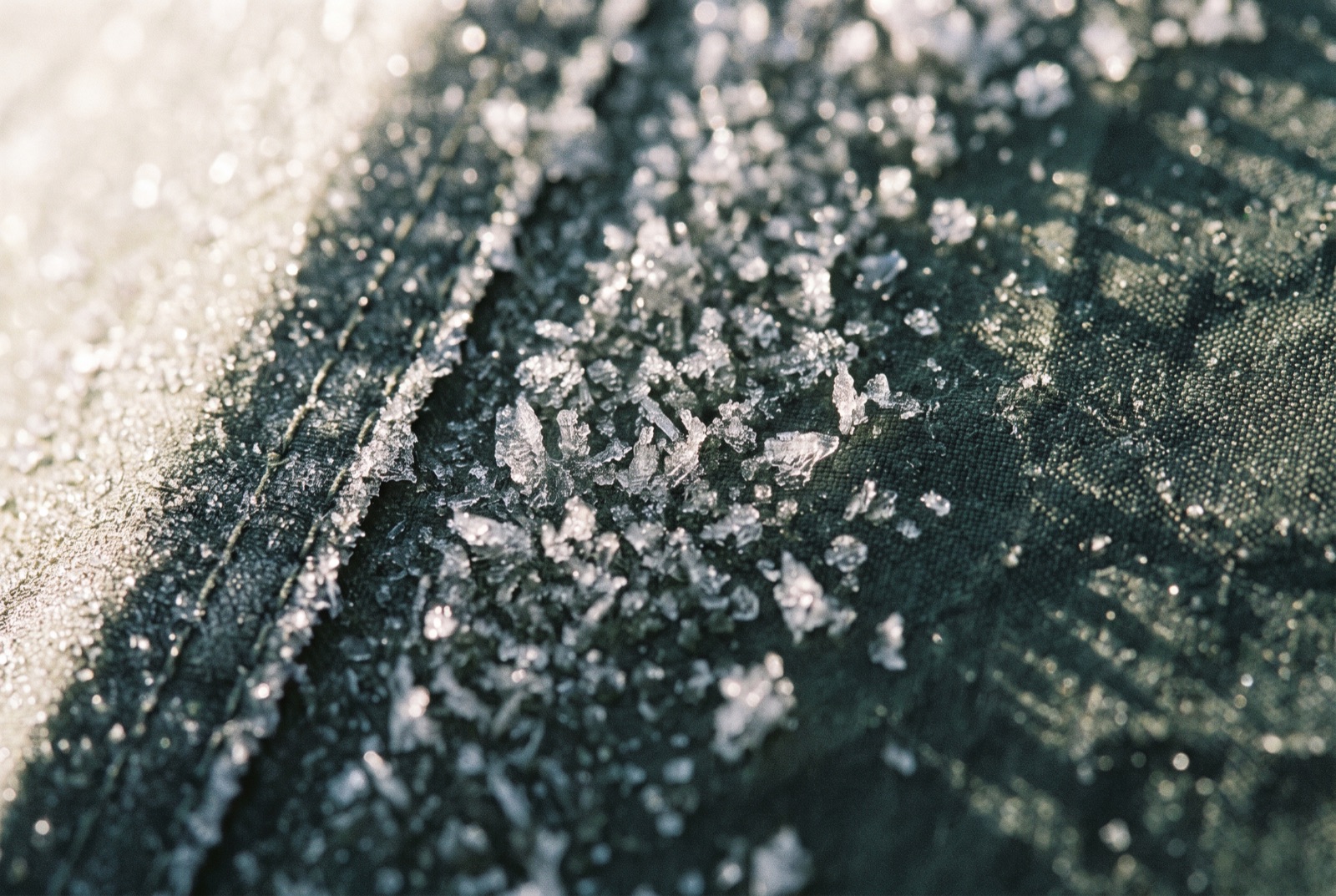
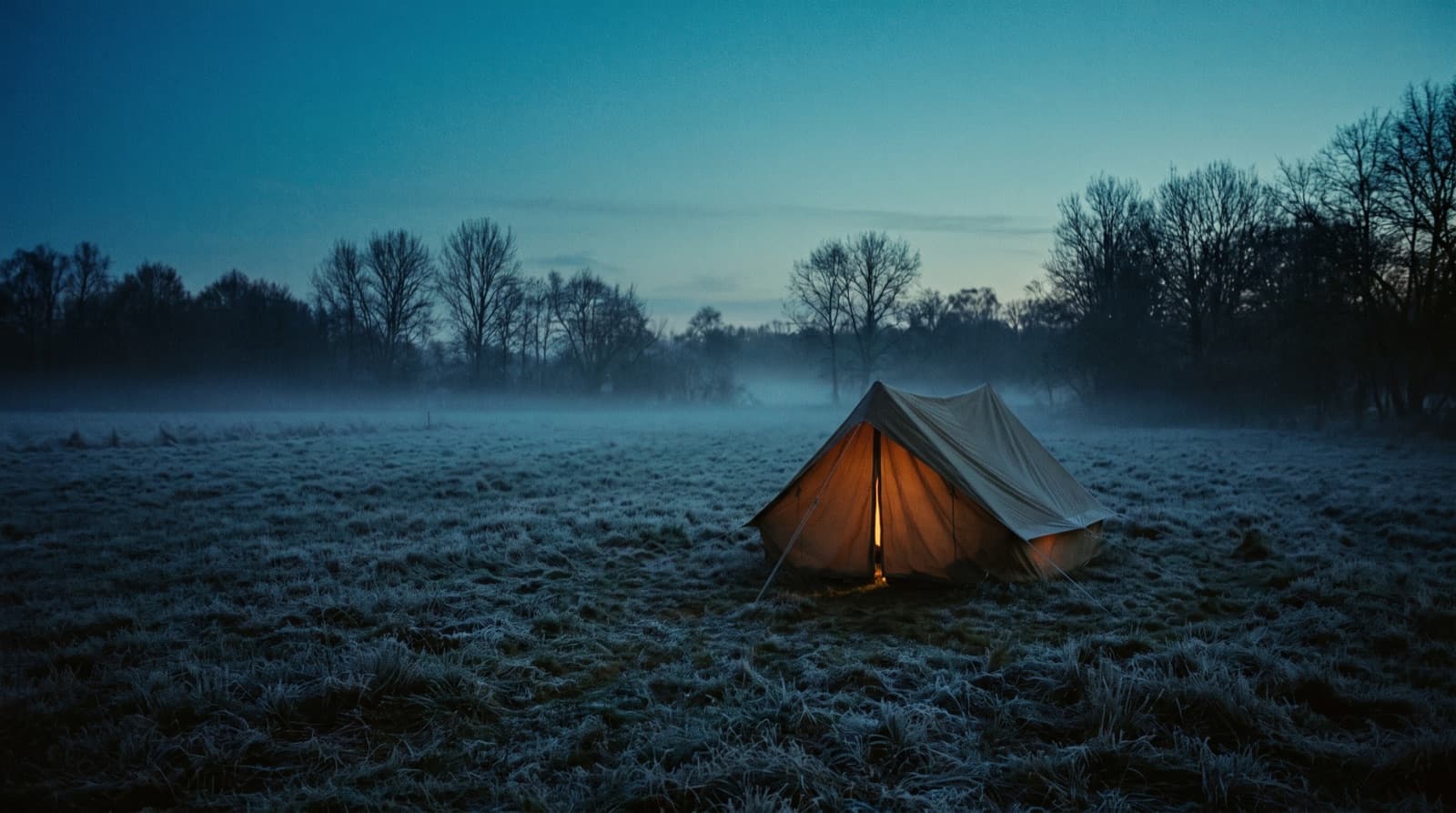
Two trips hide behind the word cold, and they are not the same trip with different numbers. Shoulder season means nights around 0–5 °C, damp, dark by five: the trip most British campers actually take. True winter means frozen ground, fourteen hours of darkness and a different kit list. Most of this is about the first; the last section is where the second departs from it.
Why you sleep cold
The short version: you are being cooled from below, and the bag rating you bought was measured on a mat. We have argued that at length elsewhere, so treat this as a signpost.
Two numbers matter. The first is the bag rating, which under ISO 23537-1 is not one number but three. Comfort is where a standard woman sleeps comfortably; limit is where a standard man does; extreme is a survival figure carrying a real risk of hypothermia, and not a specification for anything. The standard subjects are defined precisely — a man of 25, 1.73 m and 73 kg, a woman of 25, 1.60 m and 60 kg — so two people buying the same bag are sold two different promises. And the rating is measured on a heated manikin, inside the bag, on an insulating mat. The mat is part of the test. The number does not exist without it.
The second is R-value, comparable between brands since ASTM F3340 was published in 2019, which it emphatically was not before. Roughly: 1.5–2.5 is summer, 2.5–4.0 three-season, 4.0 and above winter. R-values are additive, which is the useful part. Foam of R 2.0 under an inflatable of R 3.0 gives R 5.0 — the cheapest, heaviest, least glamorous item in the shop is also the most cost-effective warmth available, and it cannot puncture.
Layering, done properly
Three layers is a description, not a rule. The functions are what matter: move moisture away from the skin, trap still air, stop wind and water. One garment can do two of those jobs. No garment does all three, whatever the marketing says.
The vapour line is where this gets decided. You dress to set off slightly cold and warm up walking, because sweat produced under a shell has to go somewhere and the inside of your insulation is the worst destination available. A soaked mid-layer at four in the afternoon is a cold night at two in the morning, and the two look unrelated at the time. Cotton loses this argument comprehensively, for reasons the rain article sets out and this one will not repeat.
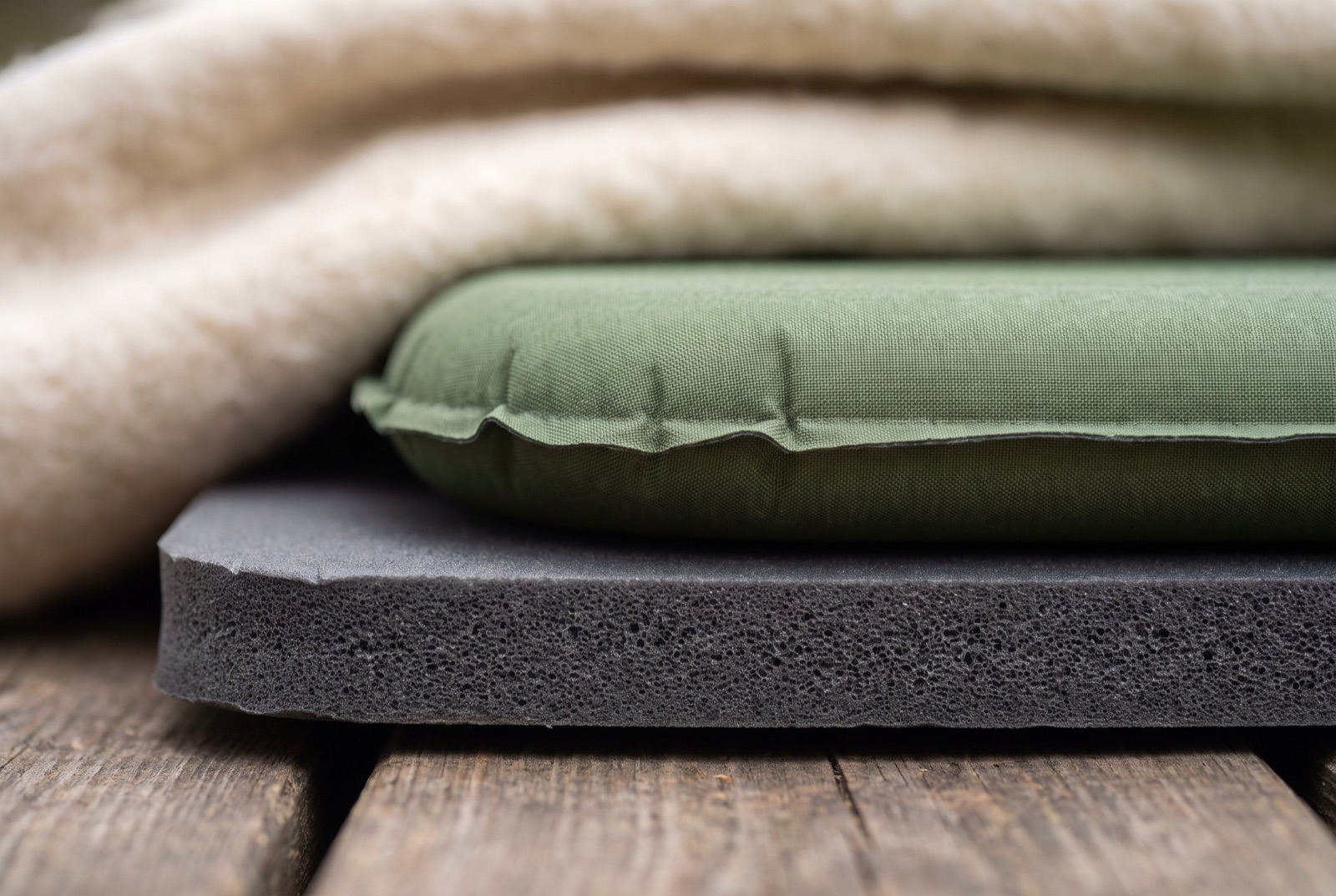
The distinction most articles miss entirely is between moving and stopping. Mountaineers call it the belay jacket principle: you carry an insulating layer you never walk in, and put it on the moment you stop, before you feel cold rather than after. At camp that is the difference between a pleasant hour making dinner and an hour spent haemorrhaging the heat you need at midnight.
What loses the argument is any system with no way to dump heat fast: pit zips, a hat you can remove one-handed, a zip you can open while walking. Shedding heat in ten seconds is worth more than another hundred grams of fill.
Moisture, condensation and the night
A sleeping adult exhales up to about a litre of water vapour overnight, and that water does not disappear. Some lands on the flysheet. Some goes into your sleeping bag, which is the part that costs you.
Down handles this badly. Wet down loses eighty to ninety per cent of its loft, and the loss is cumulative — each night the bag is fractionally flatter, and by the third you are sleeping in something that no longer resembles what you bought. Hydrophobic treatments slow that without solving it. For several damp nights in Britain, synthetic is the honest choice, and it dries far faster.
Hence the counter-intuitive instruction: vent even when it is freezing. A cold dry tent beats a warm wet one every time and by a distance, because the warmth lost through an open vent is trivial next to the warmth lost sleeping in insulation that has soaked up a night's breathing. Open the vents and accept the draught.
The routine that follows is short. Get the bag out and lofting the moment you pitch, not at bedtime. Wear a hat. Keep one pair of dry socks that live in the bag and go nowhere else. And bring nothing damp in to dry: that trick works on a thin base layer against the skin and fails badly on anything thicker.
Extremities, calories and hot water bottles
The body protects the core by abandoning the edges. Cold hands and feet are usually a torso problem reported at the extremities, which is why the fix is very often a hat rather than better gloves.
Eat before bed, and eat something slow. The body heats the bag, not the other way round, and going to sleep under-fuelled at 2 °C asks a system with nothing in the tank to run for nine hours.
Then the most reliable warmth you can carry, worked out rather than asserted. Water's specific heat capacity is about 4.18 kJ/kg·K, so a litre cooling from 90 °C to body temperature releases roughly 222 kJ — about 62 watt-hours — into your bag over the first hours of the night. Butane's calorific value is around 49.5 MJ/kg, so a 230 g canister holds something like 11.4 MJ — enough, at realistic rather than laboratory stove efficiency, for perhaps fifteen to twenty fills. The exact figure depends on your stove and the wind; the order of magnitude does not. It costs pence a night.
Two safety points, because this is the one thing here that can hurt you. Nalgene's Tritan bottles tolerate boiling water; lightweight HDPE softens at around 67 °C and is rated for regular use only to about 93 °C, so check what you own before you pour. And the bottle goes at the feet or between the thighs, inside a sock, never against bare skin.
Nobody has ever woken at three in the morning wishing they had brought a thinner mat.
Cabins are a different problem
Half of this site is cabins, and a cabin in February does not fail the way a tent does. It is rarely under-insulated. It is under-fuelled and over-sealed, a different problem with a different set of questions.
Ask four things before booking. How does the heating work overnight — is there anything besides the burner, and does it run while you sleep? Is the wood included, and how much, because "logs provided" can mean a basket a night or one bag. Are the pipes lagged, which decides whether a cold snap is an inconvenience or no water at all. And is there a working carbon monoxide alarm: in England, since 1 October 2022, one has been legally required in any room containing a fixed combustion appliance other than a gas cooker, which covers wood burners, open fires and biomass boilers. The rules differ across the UK nations, so check locally rather than assume — and if any answer is vague, that is itself an answer.
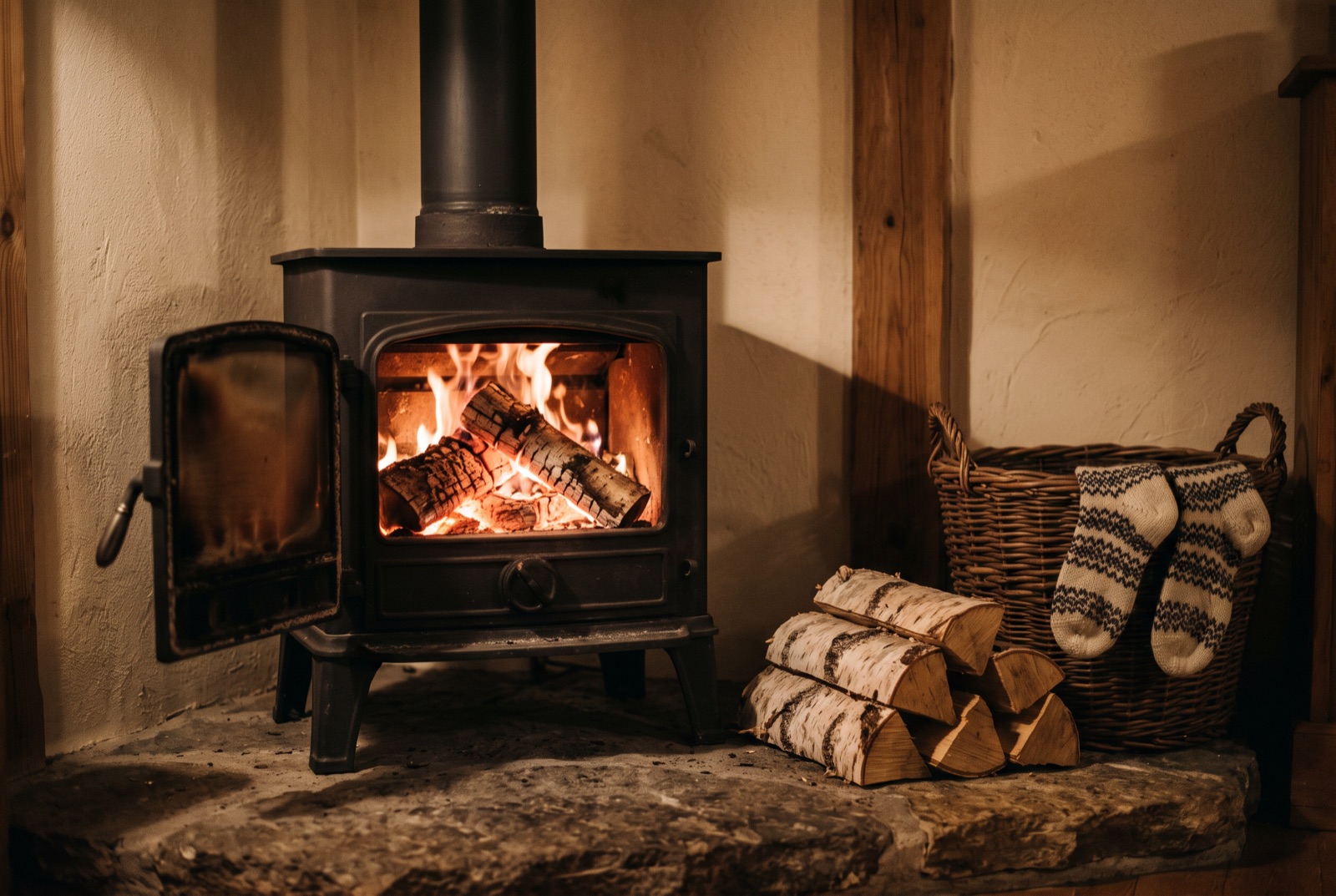
A wood burner is an evening, not a night. It will be out by two and the cabin cold by six, so plan for the walk from bed to bathroom rather than the hour spent admiring the fire: slippers, a torch for an outside step that will be icy, a blanket that lives on the sofa, and considerably less clothing than you think, because a cabin has drying space and a tent does not. Some places are simply built for this and some are padlocked from November, and we keep a list of which is which.
Shoulder season versus true winter
Where the kit list genuinely changes is a shorter list than the internet suggests. Mat R-value goes up, first rather than last. Mitts replace gloves, because separated fingers cannot warm each other. A vacuum flask filled at breakfast becomes serious equipment. Fourteen hours of darkness makes light a requirement, and head torch batteries fail faster in the cold. And everything takes twice as long, because cold hands are stupid hands — an argument for fewer, larger, simpler items.
What does not change is everything else: the vapour line, dry sleeping clothes that never go outside, food before bed, a mat that does its job. Wind changes the arithmetic — still air at 2 °C is pleasant and the same air at 30 mph is not — but that is a pitching decision rather than a clothing one, and belongs to packing for wind. Heat inverts all of it, the bag becoming a liner and a sheet, in packing for heat.
The honest closing position is that the shoulder season is the better bet for most people: empty sites, low prices, decent light, nights survivable with kit you already own if you use it properly. True winter is a specialist trip pretending to be a seasonal one, and the difference is not a colder night. It is that nothing you got wrong is recoverable before morning.