The bag says minus five. You were cold in June. Both of those things can be true, and the reason sits in a paragraph of ISO 23537 that no retailer prints on the swing tag: the number was measured with a manikin lying on a mat of a specified thermal resistance. Change the mat and you change the rating, and nobody tells you by how much.
The number on the bag is a test result
A temperature rating is not a property of a sleeping bag in the way that its weight is. It is the output of a laboratory procedure. ISO 23537-1 — first published as ISO 23537 in 2016, superseding the older EN 13537, and revised as ISO 23537-1:2022 — puts a heated manikin in a climatic chamber, dressed in a long-sleeved thermal top, long underwear and knee socks, and measures how much power it takes to hold it at a steady temperature.
Two things follow immediately. The first is that the rating assumes base layers, not pyjamas and certainly not the clothes you drove up in. The second is that three published figures come out, and they are not interchangeable. Comfort is defined against a "standard woman" — 25 years old, 5 ft 3 in, 132 lb, that is 1.60 m and 60 kg — lying relaxed and not shivering. Limit is defined against a "standard man" of 25, 5 ft 8 in and 154 lb, or 1.73 m and 70 kg, curled up and not shivering. Extreme is a survival figure, not a sleeping temperature, and shops that quote it as one are being slippery.
That gendered basis explains roughly half of the arguments happening in half the tents in Britain on any given weekend. Two people, one bag design, two different numbers, both correct.
The standard is honest about what it cannot do. It says it may not hold for children, for temperatures below −20 °C, or for bags with extra insulation in local areas. It is a static test, so it cannot measure the draughts you create by turning over, or fill that has clumped after four wet nights.
And underneath all of it, holding up the whole result, is the mat. The manikin lies on a foam mattress of thermal resistance R = 0.85 ± 0.06 m²·K/W, measured to ISO 11092, itself laid on an artificial ground of wooden board about 20 mm thick, raised clear of the floor with air circulating beneath.
What a mat's R-value is, and who decides
The unit trap is the thing this whole subject turns on. That RSI 0.85 is the SI figure, in m²·K/W. The number printed on sleeping mats in the shops is the imperial one, and the conversion factor is about 5.68. So the ISO test mat is RSI 0.85 and R 4.8 — the same mat, described two ways, which is why you will see the test pad quoted as both and conclude that one of the sources is wrong. Neither is.
R 4.8 is a warm mat. It is warmer than the mat most people reading this own.
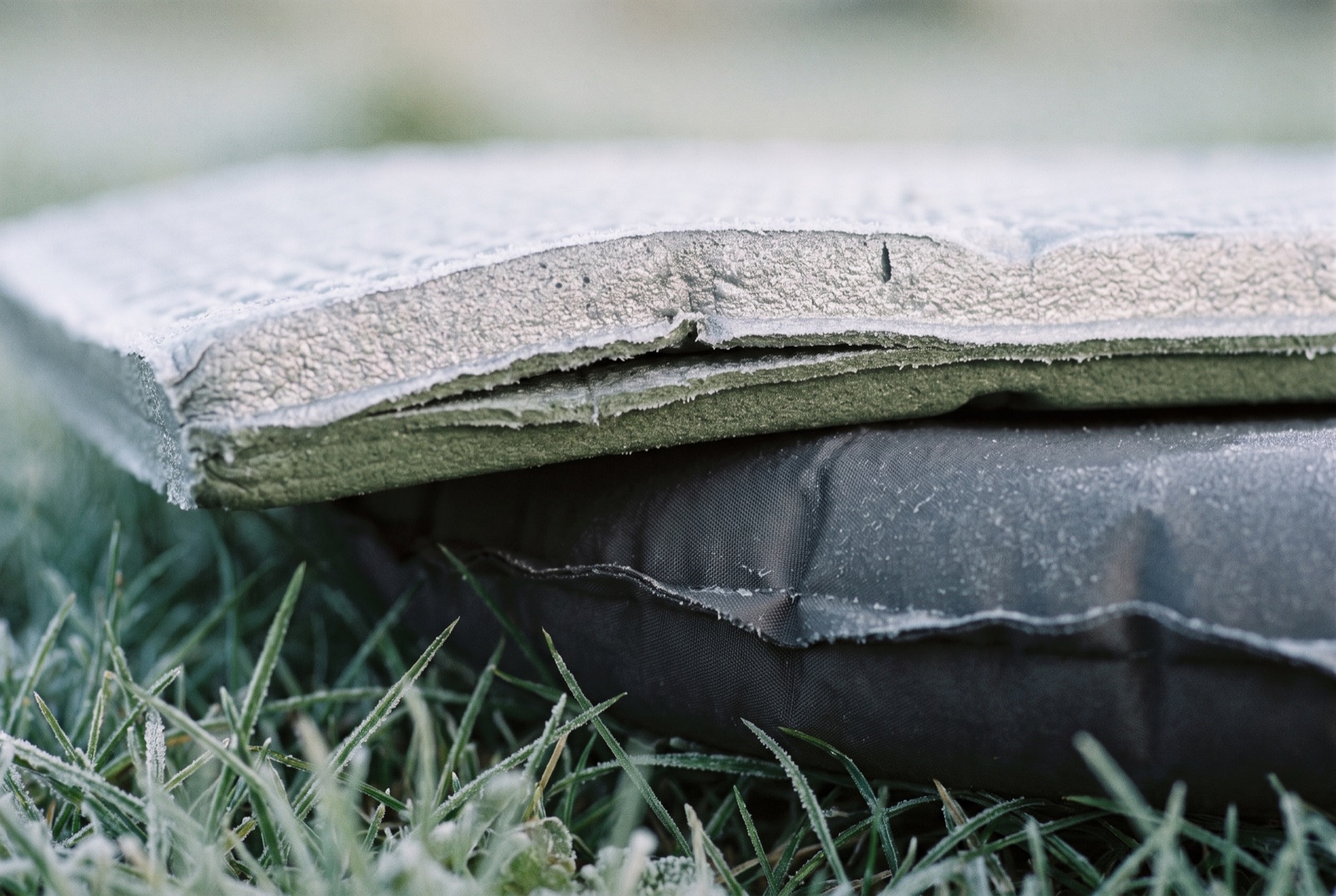
The figure is at least trustworthy now, which it was not a decade ago. ASTM F3340-22, the "Standard Test Method for Thermal Resistance of Camping Mattresses Using a Guarded Hot Plate Apparatus", clamps the mattress under constant compressive force between a warm plate and a cold one and measures one-dimensional vertical heat transfer. In practice: the upper plate sits at 35 °C, roughly body temperature, the lower at 5 °C, roughly cold ground, and the test runs over four hours. The less energy needed to hold the top plate steady, the higher the R-value.
Therm-a-Rest was a founding member of the working group, which began in 2016; the standard was published in 2019 as F3340-18 and revised to F3340-22. Before it, R-values were marketing. Now they are comparable between brands, which makes the comparison in the next section possible at all.
The mismatch, stated plainly
A typical summer mat is R 1 to R 2. The comfort rating on the bag above it was established on R 4.8. That is the whole problem, and no amount of down will fix it, because of what happens to insulation under a body.
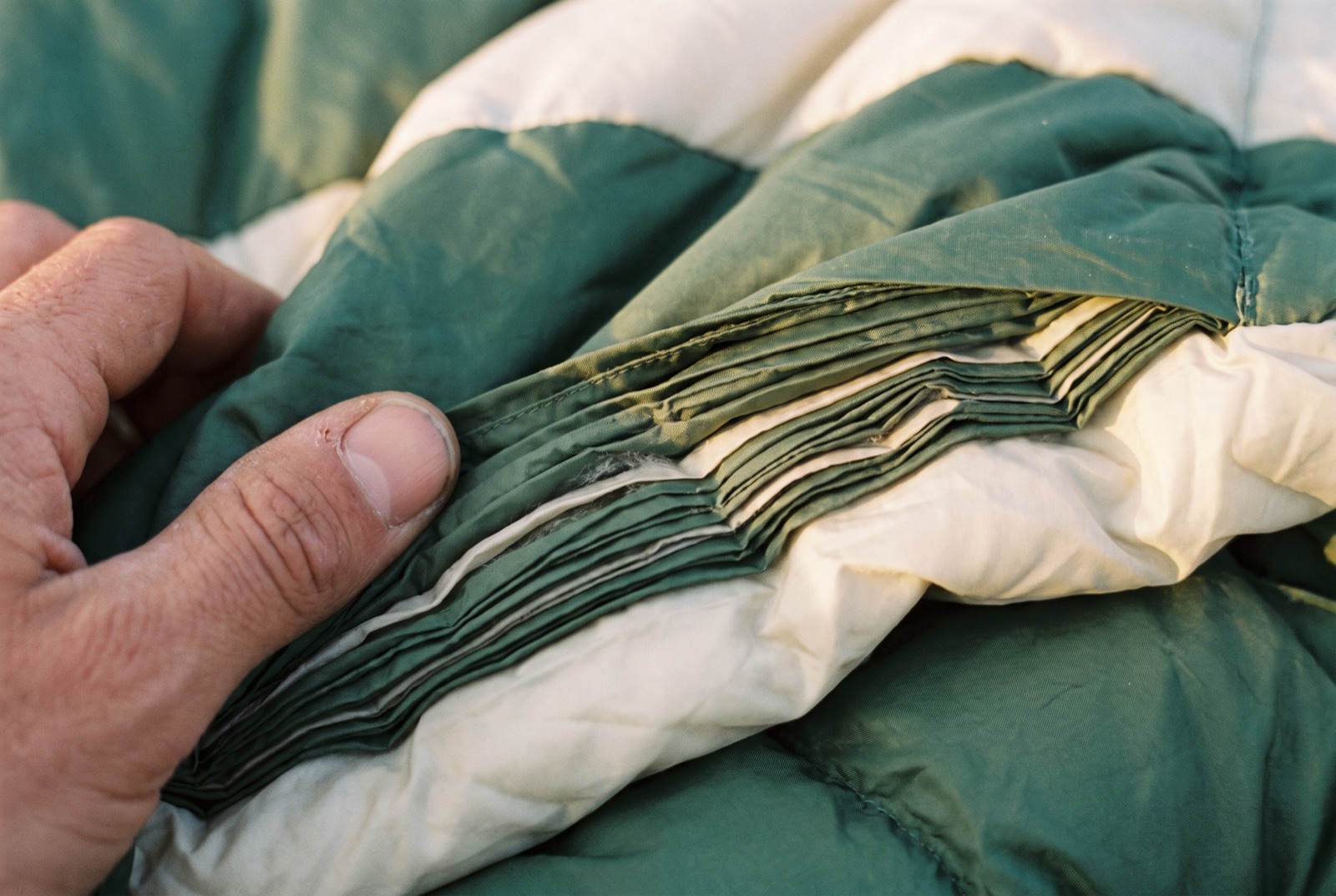
Loft is the mechanism. Down and synthetic fill work by holding still air, and under the weight of a sleeping person the fill beneath you is crushed to nothing. Functionally, all of your under-insulation is the mat, whatever the bag cost. The expensive bag and the cheap one are close to identical from below.
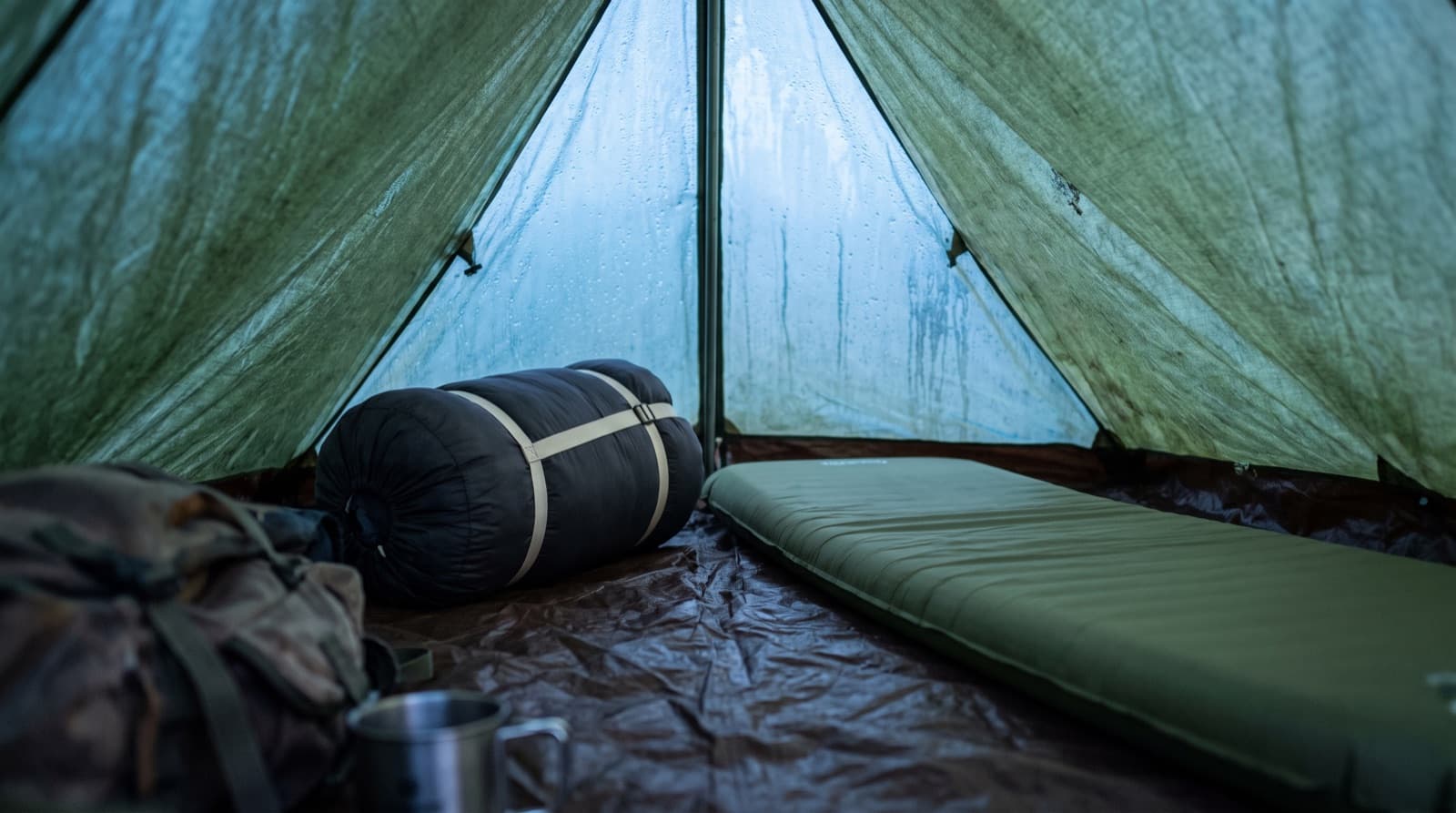
Air beds deserve their own paragraph, because they are the single most common cause of a cold night in a British family tent. A tall uninsulated air bed rates around R 0 to R 1 — effectively no insulation at all — and it is worse than nothing in one specific way: the air inside it is free to move, so it sets up a convection loop, warmed against your body, falling to the cold ground, circulating, and carrying your heat downwards all night. A bag rated to −7 °C under-performs badly on one, and the owner blames the bag.
You will also read that some fixed percentage of body heat is "lost to the ground". The figure is quoted everywhere and traceable nowhere, and it is not needed to make the argument.
The honest table
| R-value | What it is for | Alpkit's temperature guide |
|---|---|---|
| R 1–2 | Summer | R1 ≈ 10 °C, R2 ≈ −1 °C |
| R 3–4.5 | Three-season | R3 ≈ −4 °C |
| R 4–4.5 | Camping around freezing | R4–R5 ≈ −12 °C to −18 °C |
| R 5+ | Winter | R7 ≈ −32 °C |
The left two columns are broad industry consensus. The right-hand column is Alpkit's own published guide and it is more optimistic than the consensus — R 4 to R 5 is sold as three-season kit and rated by Alpkit to −12 °C. Treat both as a starting point rather than a promise, note that they disagree, and if you sleep cold, go up a step.
The useful part is that R-values are additive. Stack two mats and you add their figures, which makes the cheapest warmth in camping a slab of closed-cell foam. A Therm-a-Rest Z Lite Sol is R 2.0 at about 14 oz; put it under a NeoAir XLite NXT at R 4.5 and 369 g and you have R 6.5 for the price of a takeaway and almost no bulk penalty — within touching distance of a NeoAir XTherm NXT at R 7.3 and 440 g, for a fraction of the outlay. For UK reference points, Alpkit's Whisper is R 2, the Dirtbag R 3, and the Radiant R 7.2.
The rating on your bag was measured with a manikin lying on a mat warmer than yours. Everything after that is arithmetic.
The four things that are not the mat
Going to bed cold. A sleeping bag is insulation, not a heater — it can only slow the loss of heat you are already producing, and it cannot warm a body that has stopped producing much. Ten minutes of moving about, or getting in warm rather than getting in to warm up, does more than most of the kit in this article.
Damp fill. Over four nights in a wet tent, condensation moves into the bag from your own breath and body, loft drops, and Thursday's bag is quietly a colder object than Monday's. Air it in any dry hour you get. The same argument about vapour and where it goes runs through everything on a jacket's label.
Draughts. A bag too large for its occupant has a volume of air to heat and a gap at the neck and shoulders through which the warm air leaves each time you turn over. The rating was measured on a manikin the bag fitted. Cinch the hood and the collar before you decide the bag was mis-sold.
Food and hydration. Being properly fed and not dehydrated helps, and that is about as far as the evidence supports. Most of what follows belongs to a wider argument about packing for cold rather than to the bag.
What to buy, in order
With £100 to spend and a cold night behind you: mat first, then a liner, then — only then — the bag. Almost everyone does this in reverse, which is the corollary of a longer point about most of what is in the boot not helping.
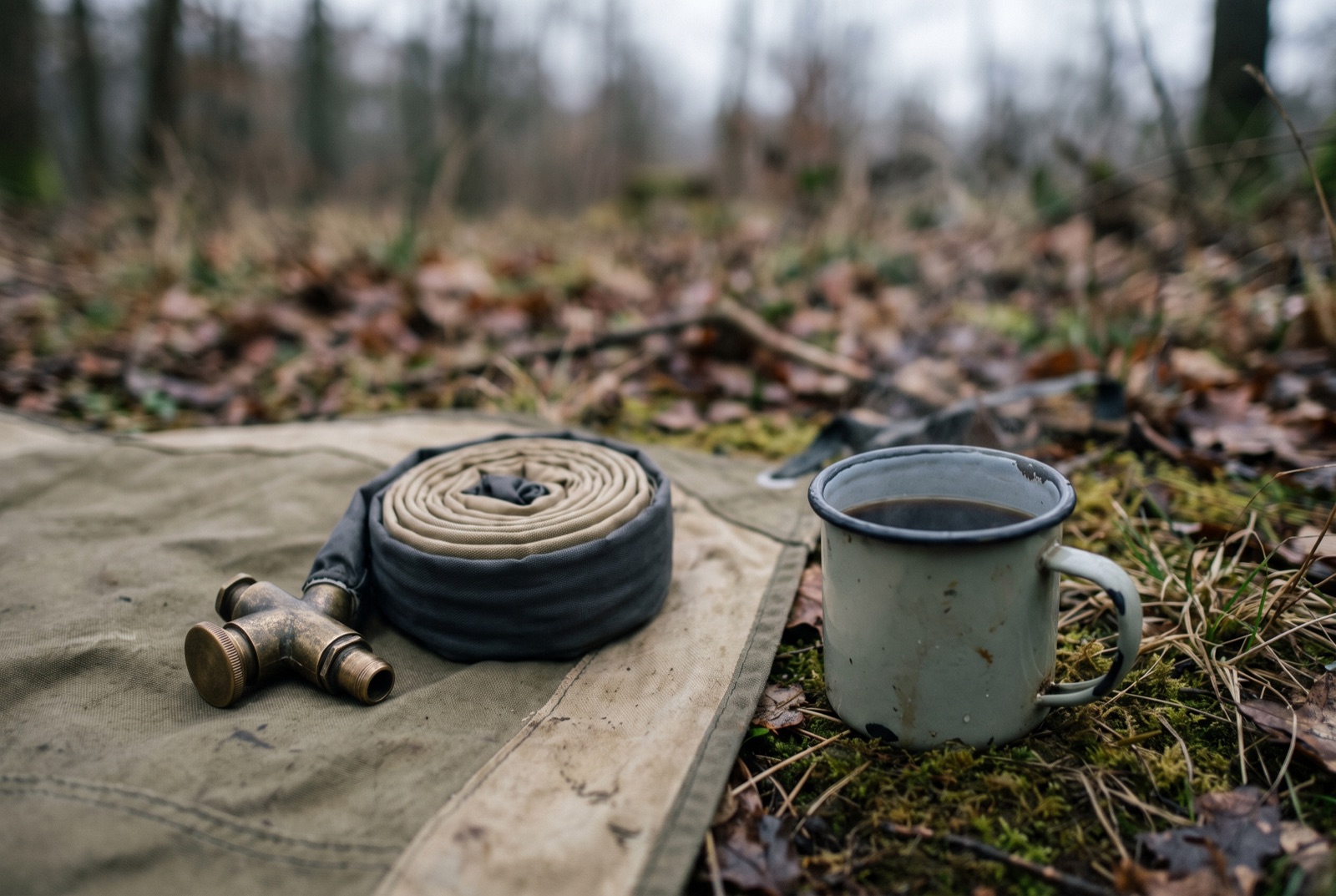
Tonight, with no shopping at all, there is still something to be done. Put the spare roll mat, the picnic blanket, the emptied rucksack, anything at all, under your hips and shoulders, which are where the weight and the heat loss concentrate. Move the pitch off the hollow, because cold air pools and you can feel the difference between a dip and a rise of half a metre. Put dry socks on. Get in warm.
None of this is a reason to stop camping in the cold months — the case for going in winter survives it entirely, and one mat is a smaller obstacle than the weather is. But if you have lost this argument at home three years running, four walls, a stove and a hot tub is a perfectly honest answer, and nobody who has slept on an air bed in a Welsh October will judge you for it.